Visitor
Eocene
June 23, 2007 - Eocene Fossils, Covington Co, AL
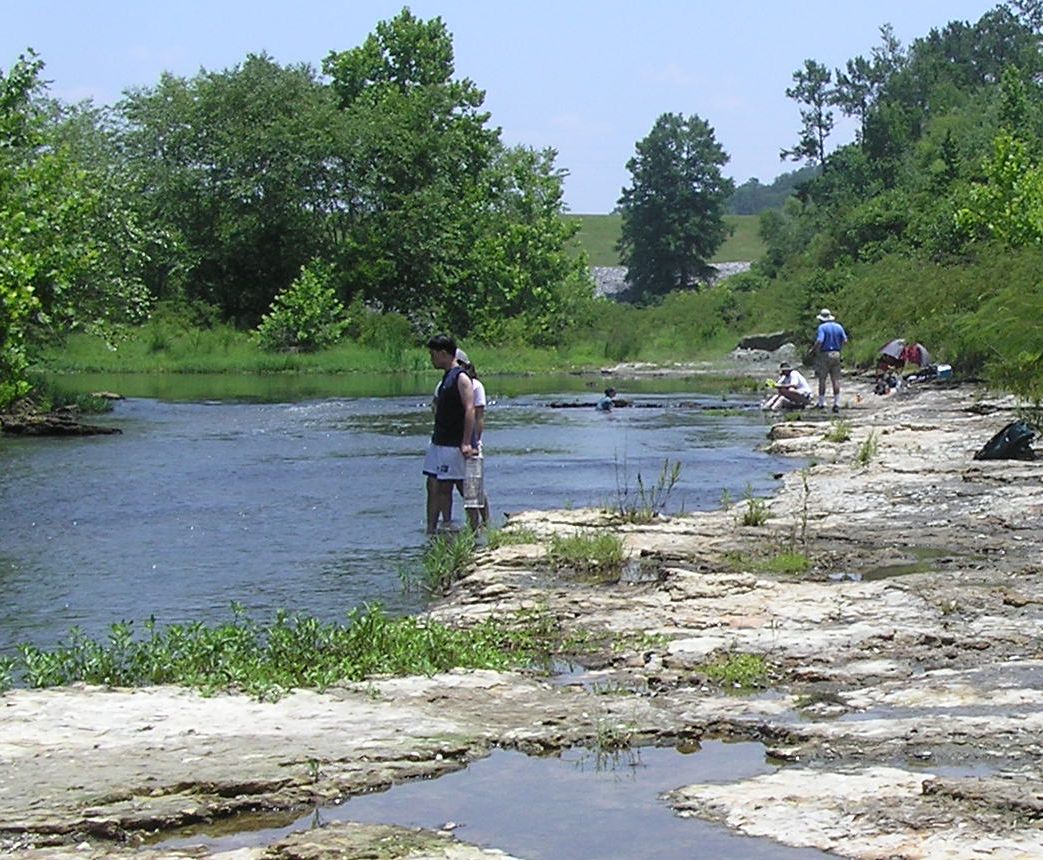
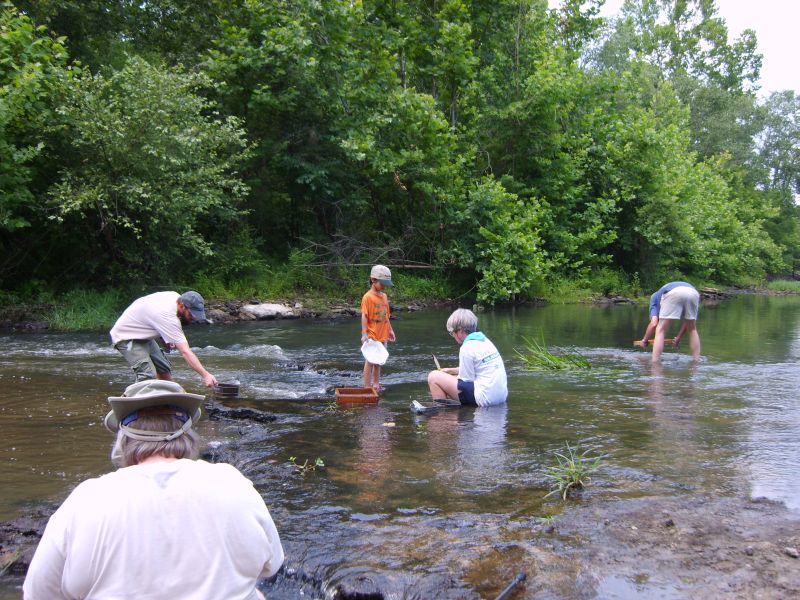
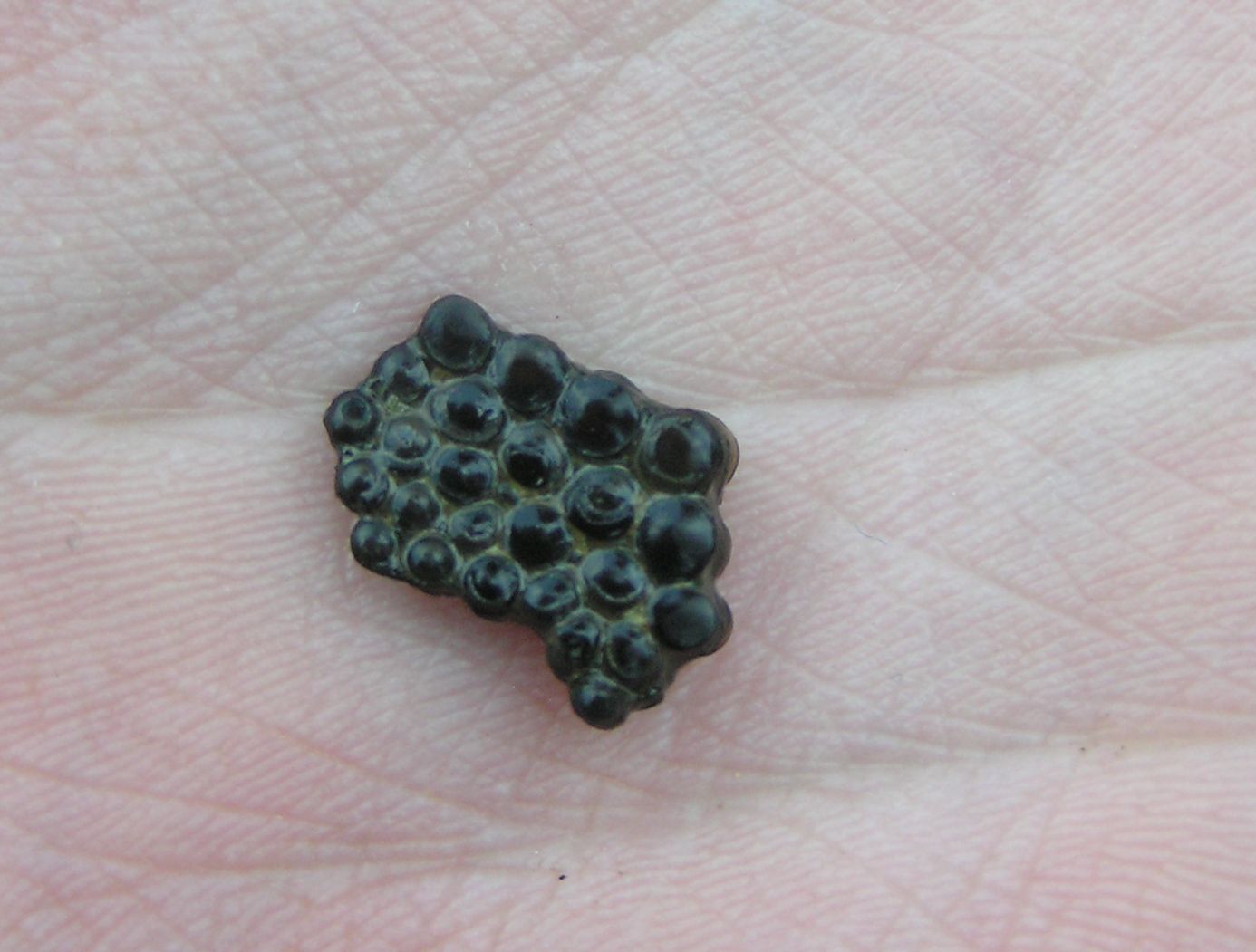
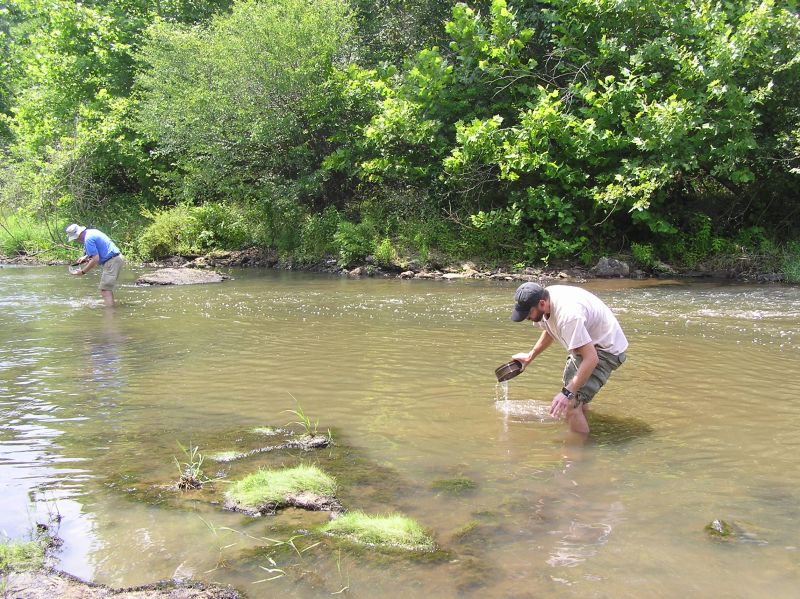
The weather was unbearably hot for this June BPS trip to a river in Covington County. Maybe it was the heat, but we had a smaller than normal turnout. The water at this Eocene age site was extremely low, and our usual collecting-holes were sometimes totally flushed clean, and sometimes filled with silt. Very odd. However, we still found some nice specimens and quite a bit of petrified wood, including what appears to be a seed pod. The group scattered along the riverbank and settled down in their chosen collecting spots, making life a little hard on the photographer, but we still got some nice pictures.
Unlike previous years, we were the only collectors that day. It appeared that some "cleanup" work had been done along the riverbank, because it was smooth and un-marred by the holes and trenches dug by commercial collectors in previous years. The landowner asked that we DO NOT DIG at this site, and hopefully, the word has gotten around (BPS never dug here, anyhow). Screening is ok, but NOT digging holes in the banks. Since a number of our members have been appalled in the past at what appeared to be irresponsible digging by people who didn't even know they needed permission to collect here, this was welcome news.
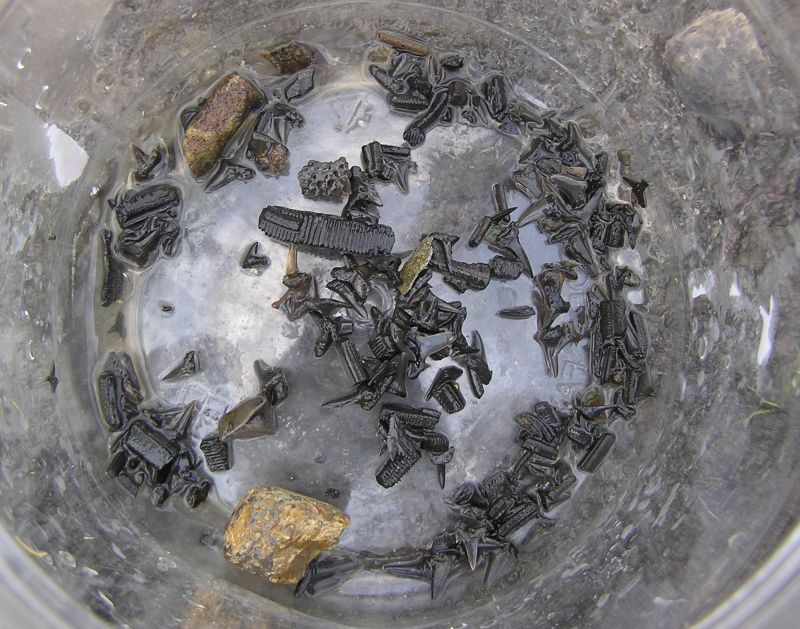
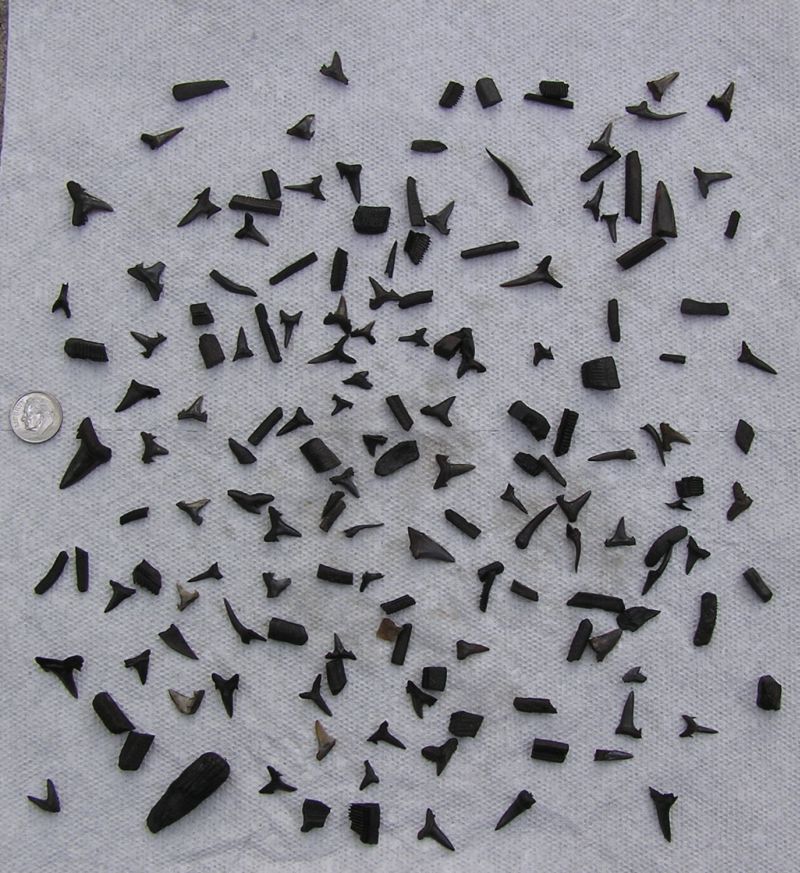
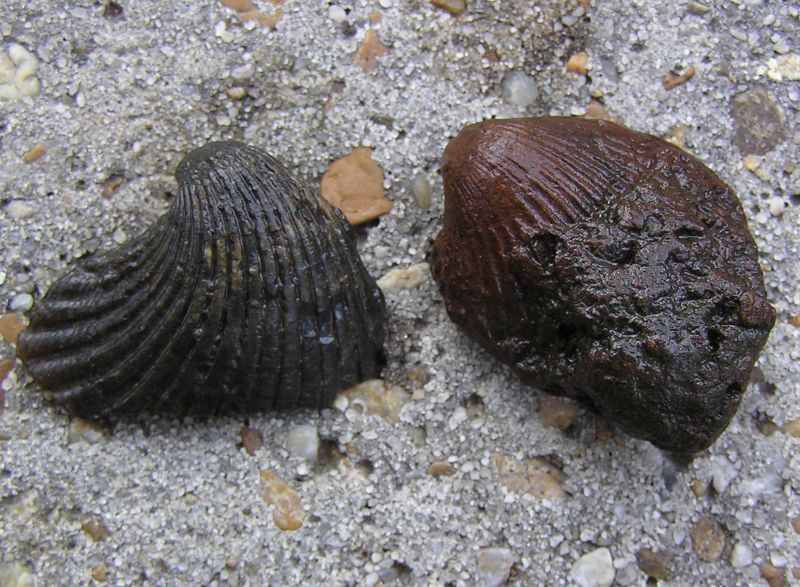
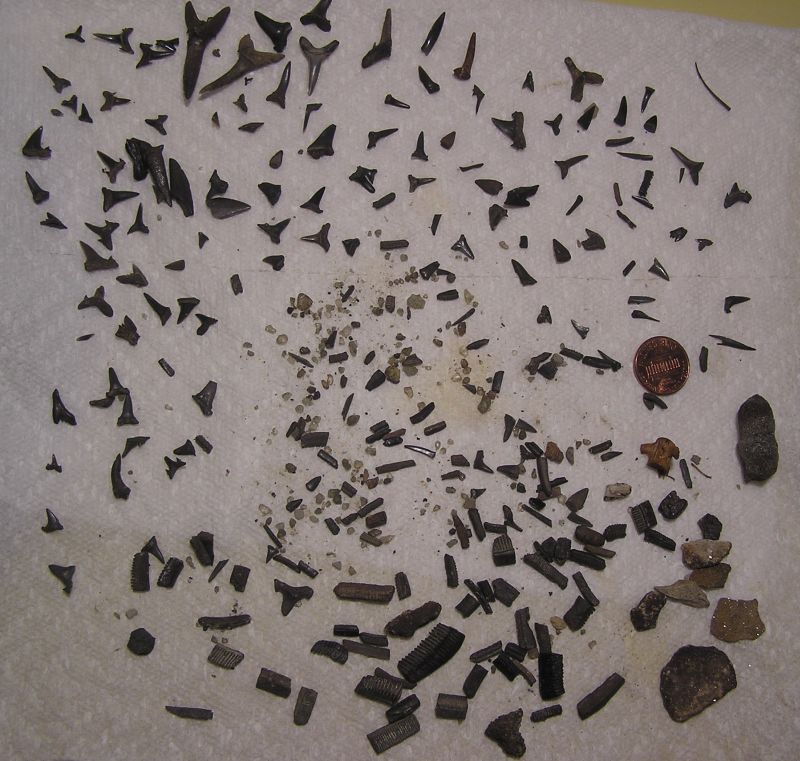
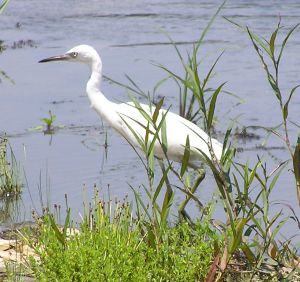
We found ray teeth, shark teeth, sting-ray spines, brachiopods, drumfish mouth plates, and some mystery pieces. Stay tuned! The river was a wonderful place to cool off on such a hot day, so BPSer's took full advantage. Several members camped out overnight (thanks for the A/C, Leisa!), and broke out the canoes the next day in hopes of spotting some more collecting areas. We found some shark and ray teeth, a live turtle badly wanting out of the hole it had fallen into, and had a very pleasant trip UP the river, but did not find the treasure hole we were seeking. So, obviously, we have to go hunting again, right guys?
--Edited by Vicki Lais
(Photos courtesy Claire Smith and Vicki Lais)
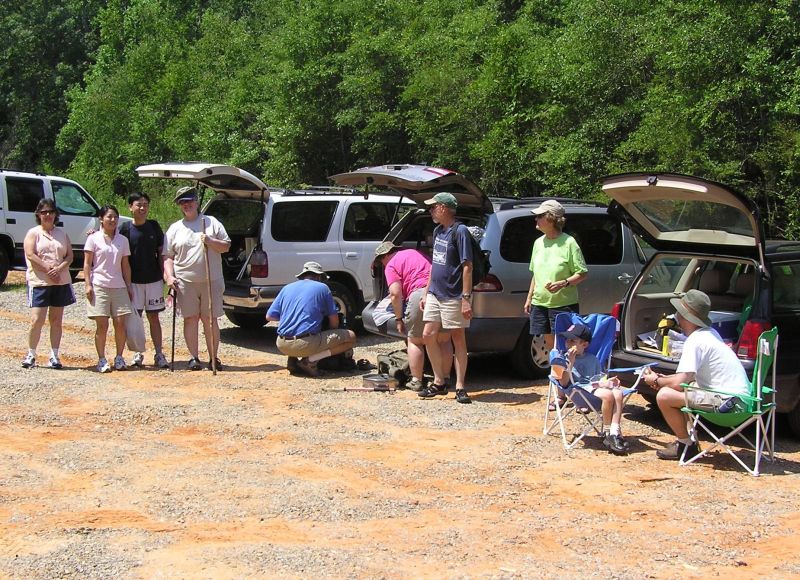
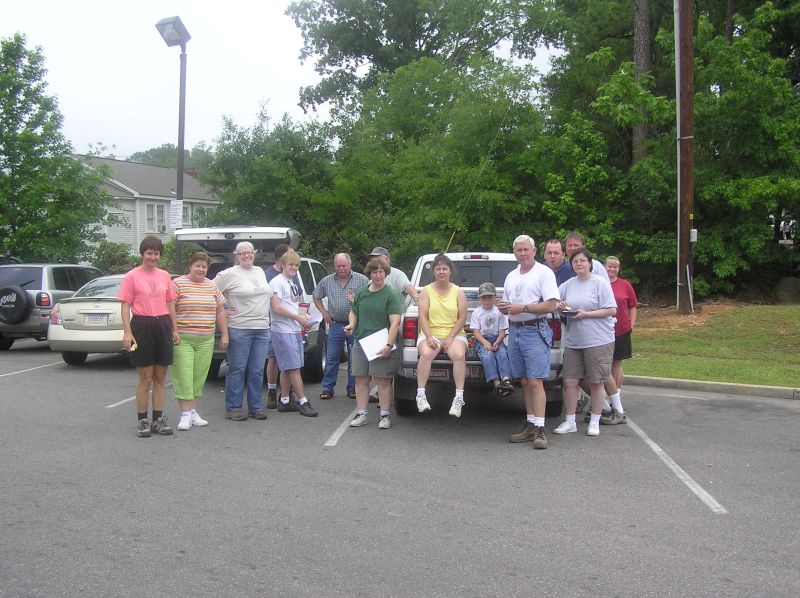
The group picture, hey, what can I say? We were late, hot, and hungry!
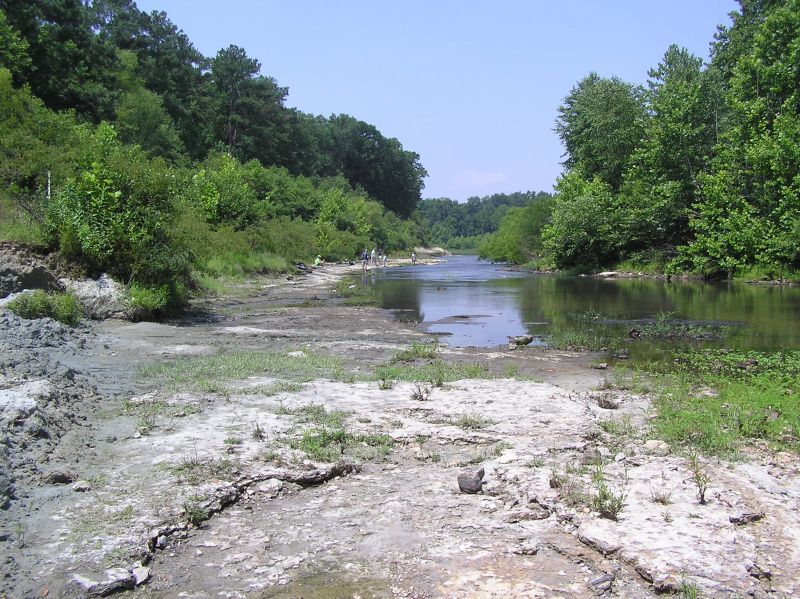
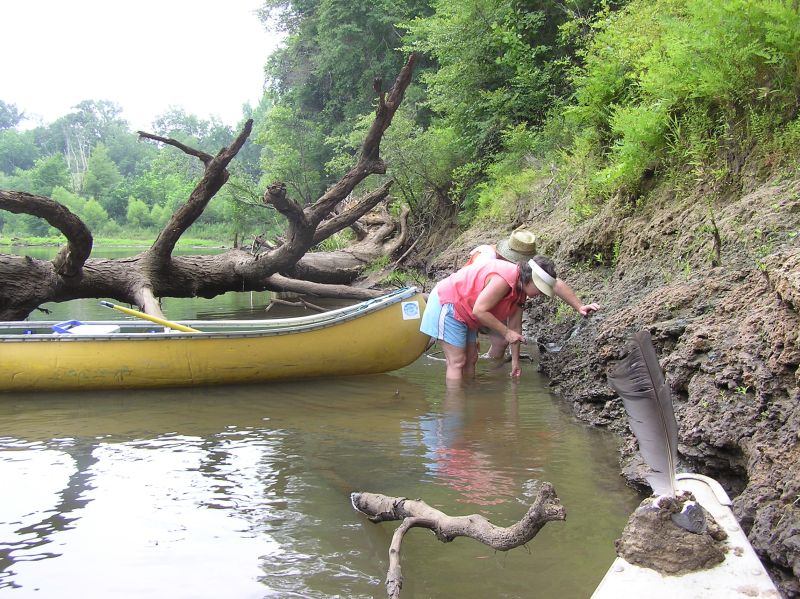
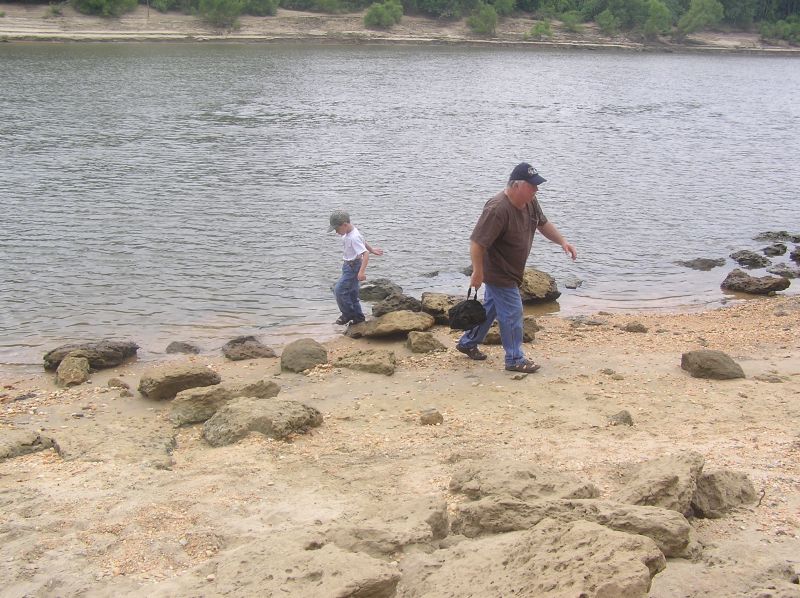
Very low water level today.
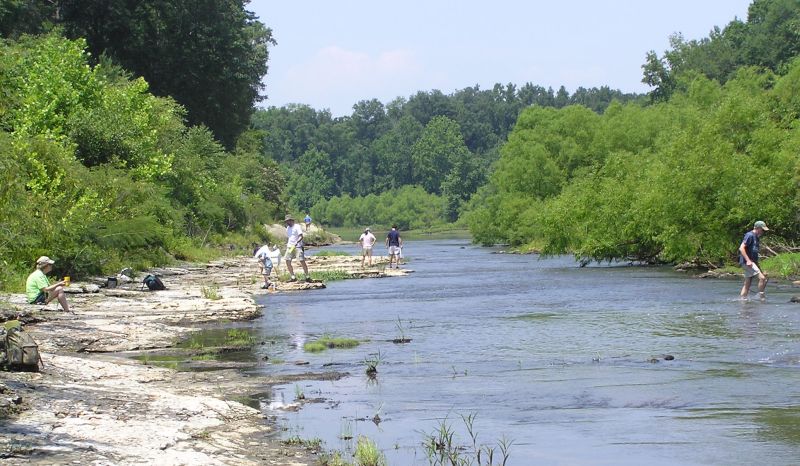
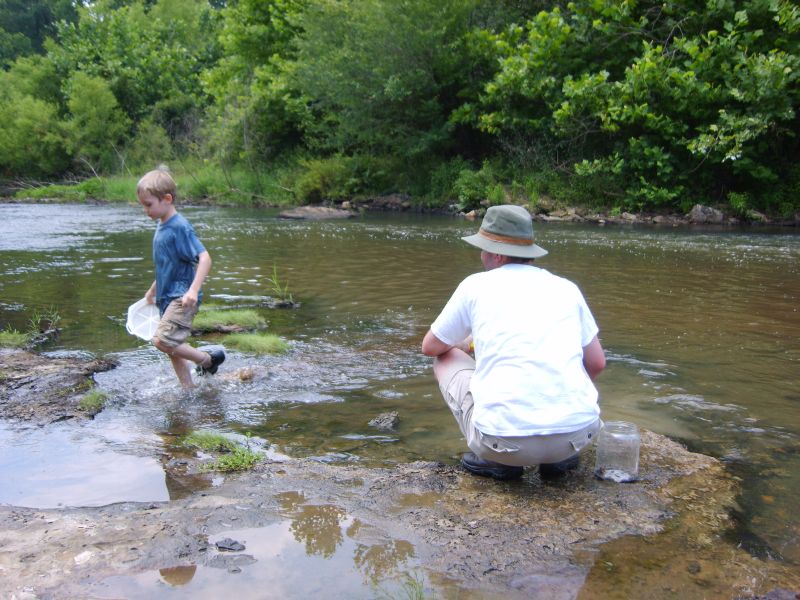
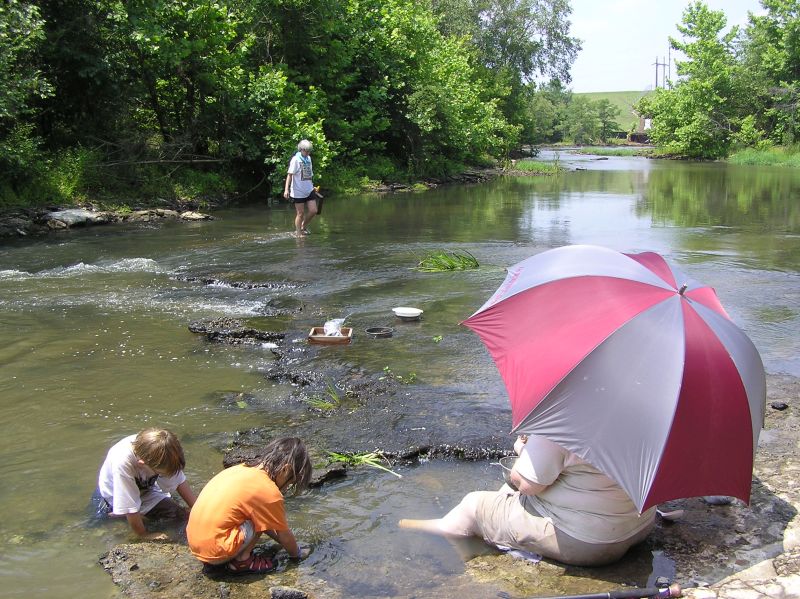
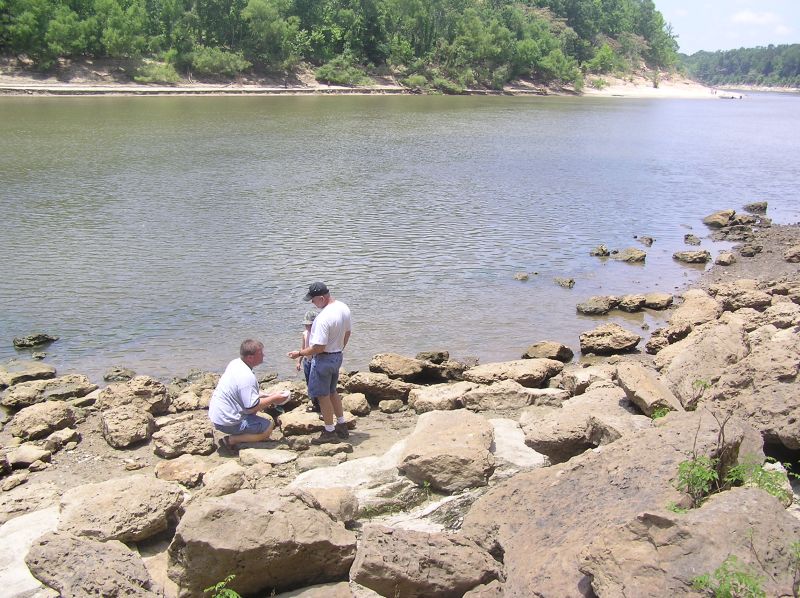
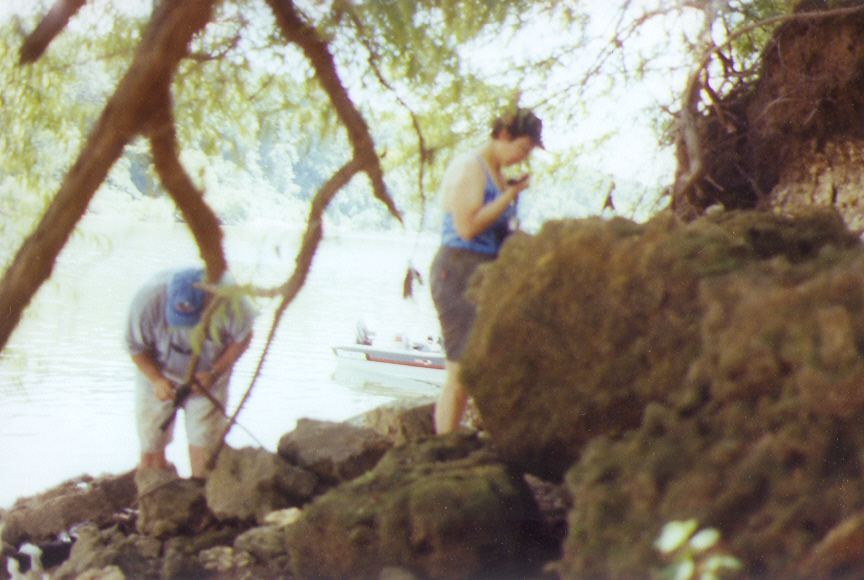
Members hunting for the best collecting spots - the river is quite shallow here.
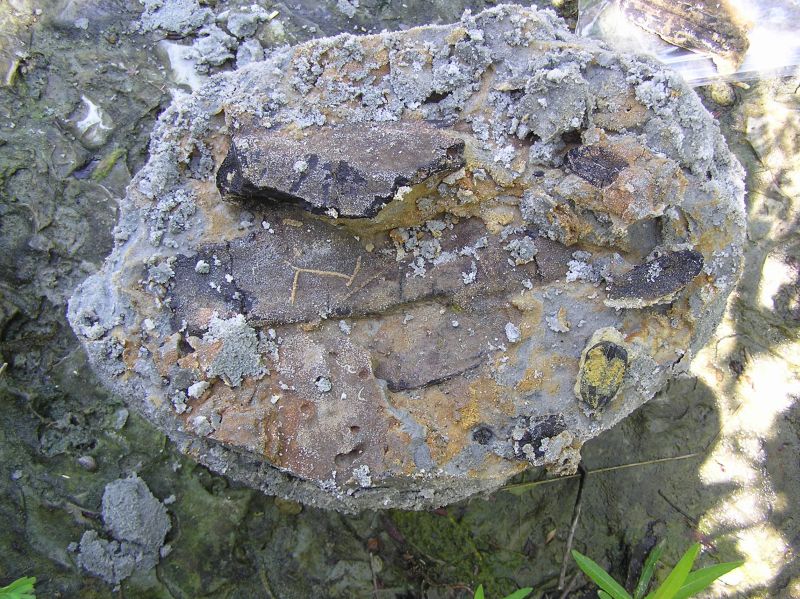
Jan found several pieces of petrified/ permineralized wood, and what appears to be a nice seed pod.
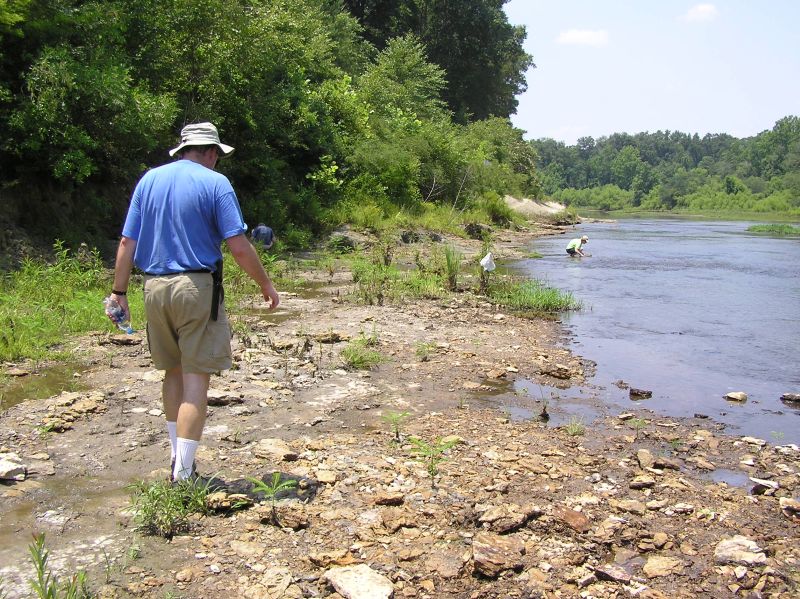
Jan heading downstream, surveying areas that are normally covered with water.
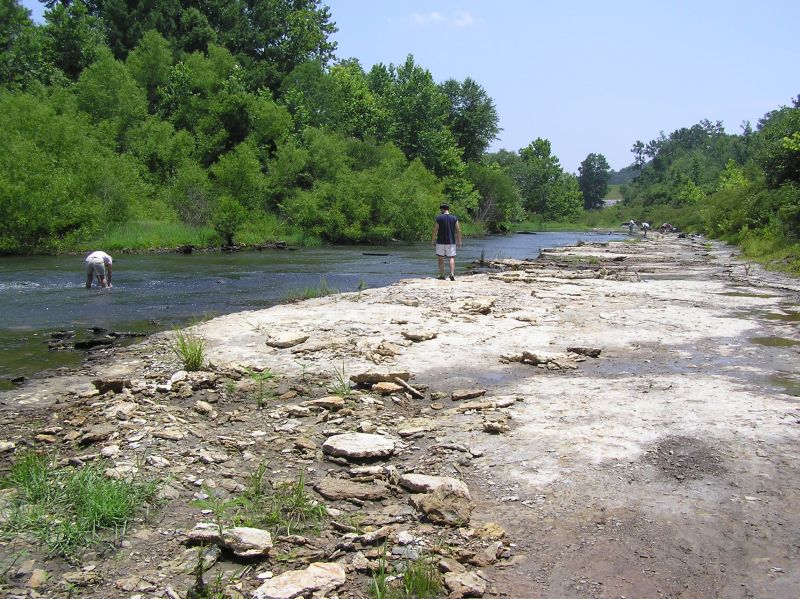
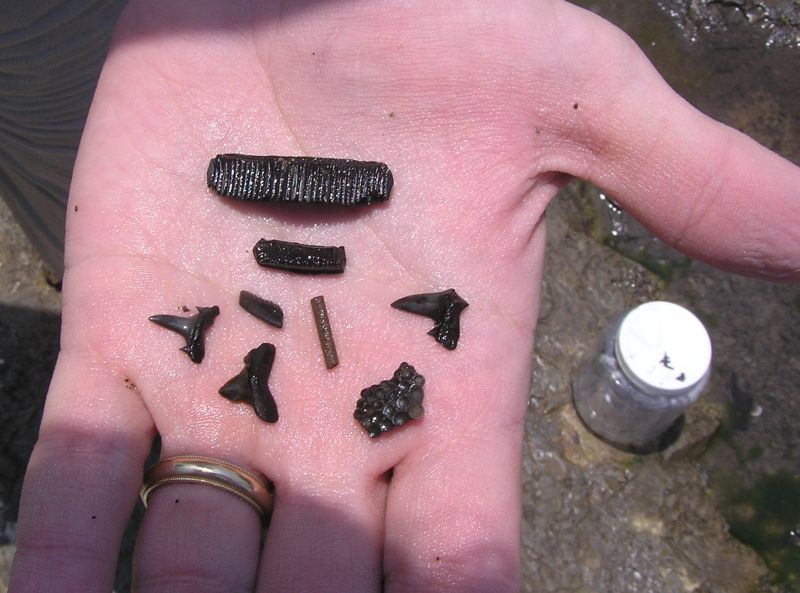
Sample of the fossils found at this site.

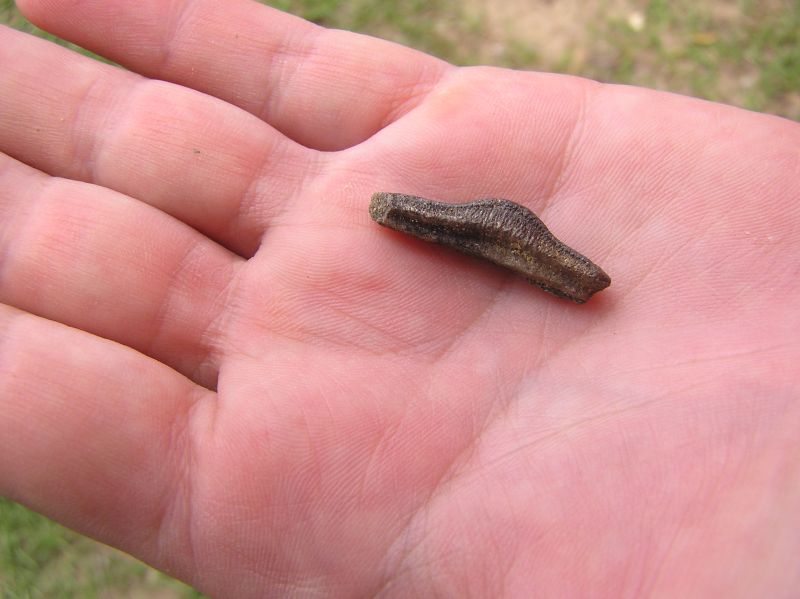
Drumfish mouth plate.
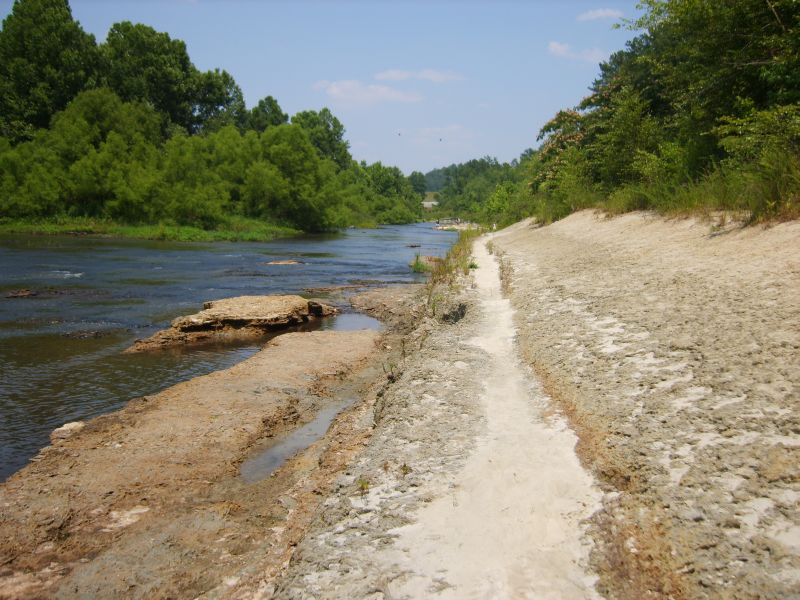
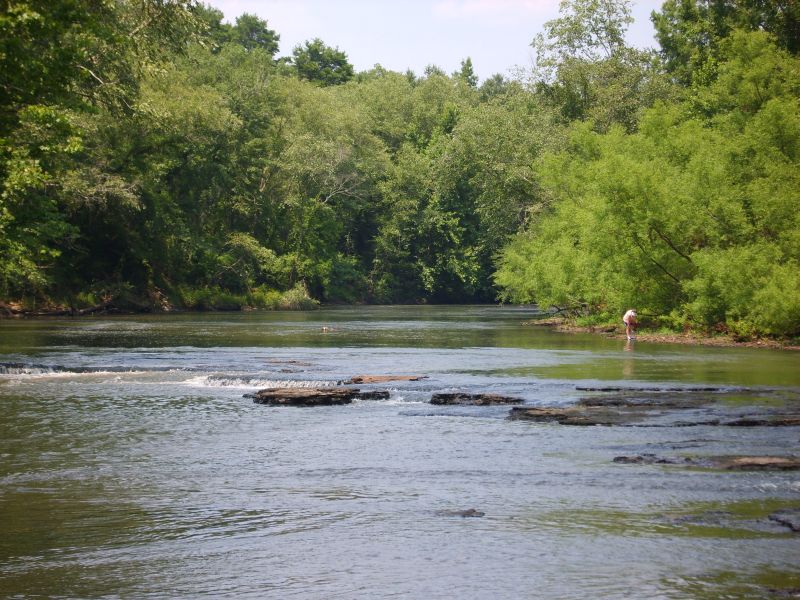
The river is low enough to expose this small waterfall, where, rumor has it, Claire and Becky engaged in a water battle.
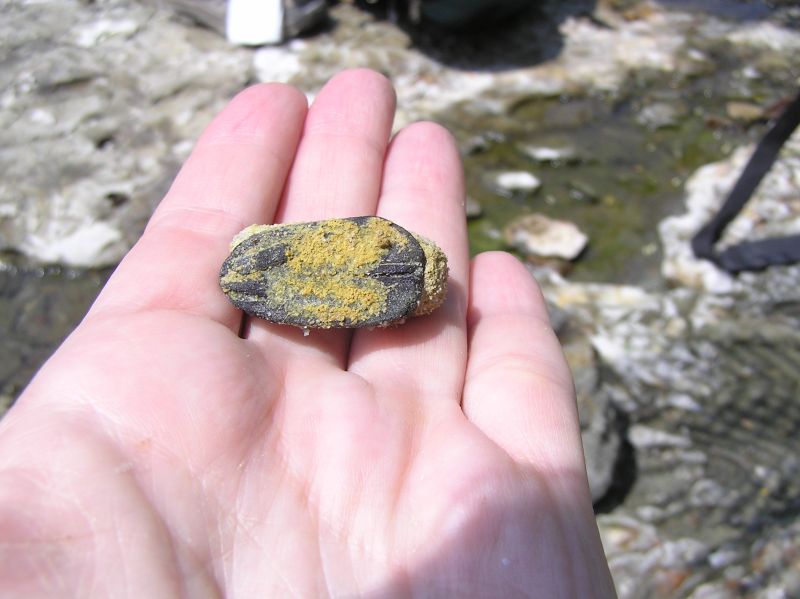
Good view of the seed found by Jan.
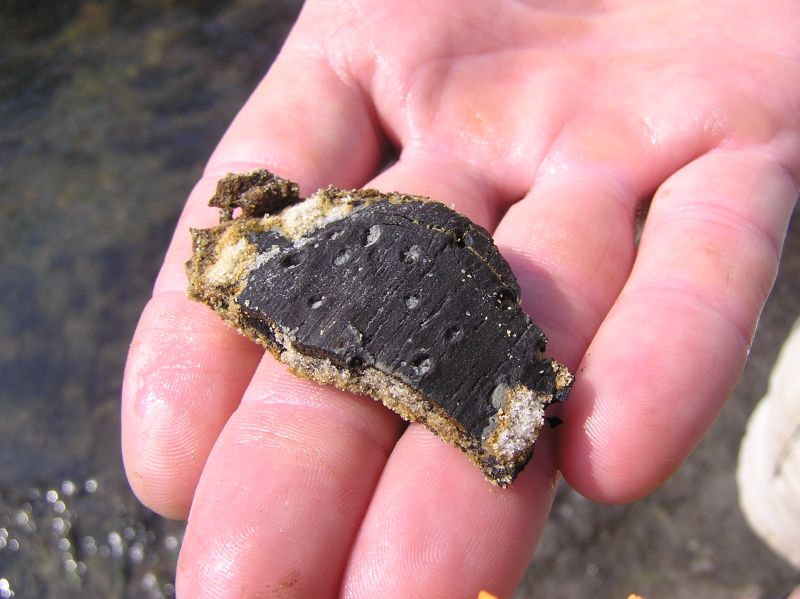
Wood found by Jan.
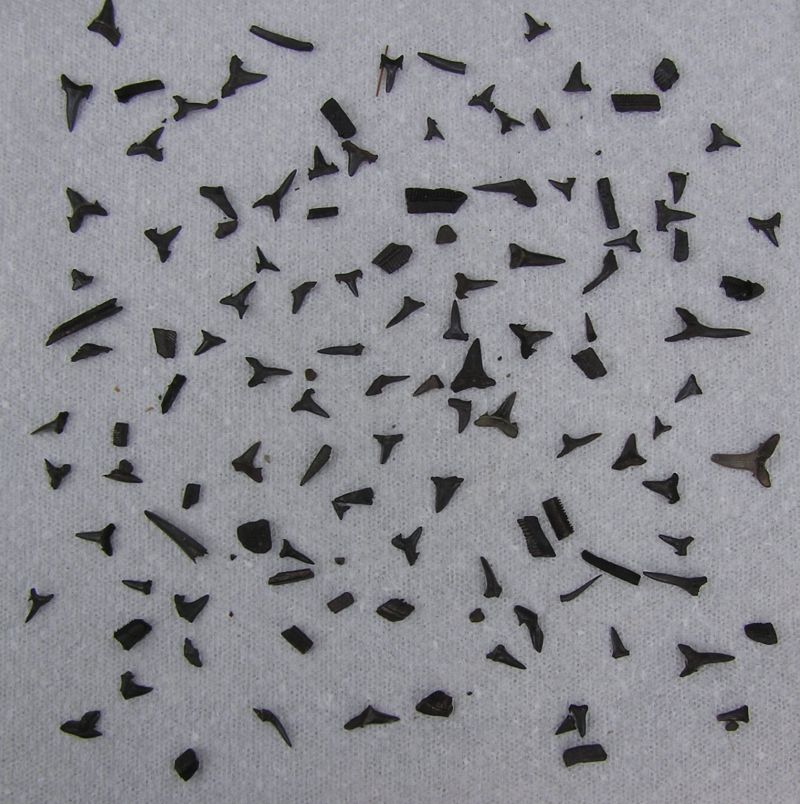
That evening at camp, we spread out our finds for the day.
June 03, 2006 - Paleocene Fossils, Clarke and Wilcox Co, AL
Today BPS went way down south to Clarke County, Alabama. We were quite excited because this was a new site Steve found, and we were chomping at the bit, ready to go. We found a good variety of bivalves and gastropods, a few shark teeth and ray teeth. The most numerous fossil we found is Flabellum cuneiforme pachyphyllum, a type of coral from the upper Lisbon formation. This is unlike any corals we have collected in the past, as it has a flattened shape, as if someone took a horned coral and squashed it. Some were tinted a pinkish color, which made them easy to spot in the mostly white matrix. At least one specimen of Endopachys maclurii was found (looks similar to the flat one, but has two bumps on each flat side), and several very tiny round specimens of Discotrochus orbignianus were found. (Specimens from this site are very fragile, and should NOT be placed in a bucket of water to clean, as they will crumble. Even the ones that look thick and solid. Brush them off dry, or very lightly wet them, then put them where they can air dry, perhaps on a wire screen.)
Later in the day we headed to Wilcox County, Alabama, to some huge road construction rubble piles. These rocks were from the Paleocene, Midway Stage. Several nice nautiloid casts (Hercoglossa ulrichi) were found at this site, as was an extremely nice vertebra, which has not yet been identified. The nautiloids are made of compressed sand, and the actual shell has disintegrated. Though they are very heavy and appear sturdy, if left exposed to the weather, or cleaned with water, they will crumble into a pile of sand.
Update: July, 2006 - on the trip, Martha found a large bone that appeared to some of us to be recent, as it was very lightweight; however, Jun Ebersole and James Lamb of the McWane Science Center asked to examine the bone, and determined it is from the only early whale of this species ever found in the state. The specimen has been sent to an early whale expert for study.
(photos courtesy Steve Corvin and Vicki Lais)
Greg is showing the group some specimens from this site - nice corals.
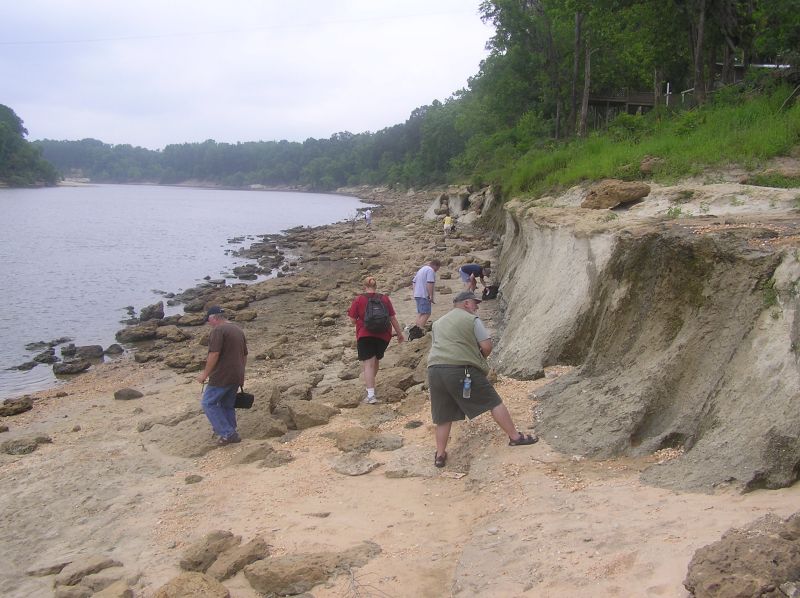
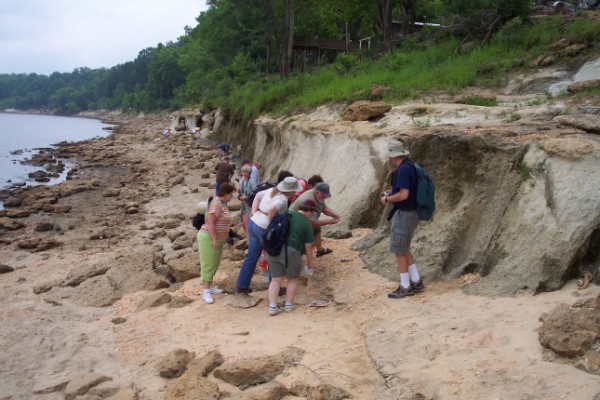
And the group scatters - the low water level makes hunting easy.
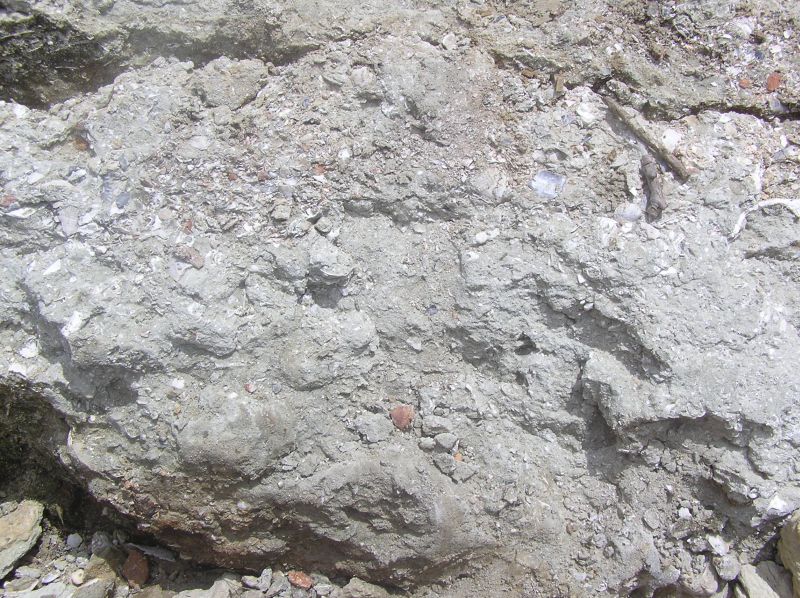
All the rocks at this site are filled with shells and corals. The trick is getting them out whole, as they easily crumble.
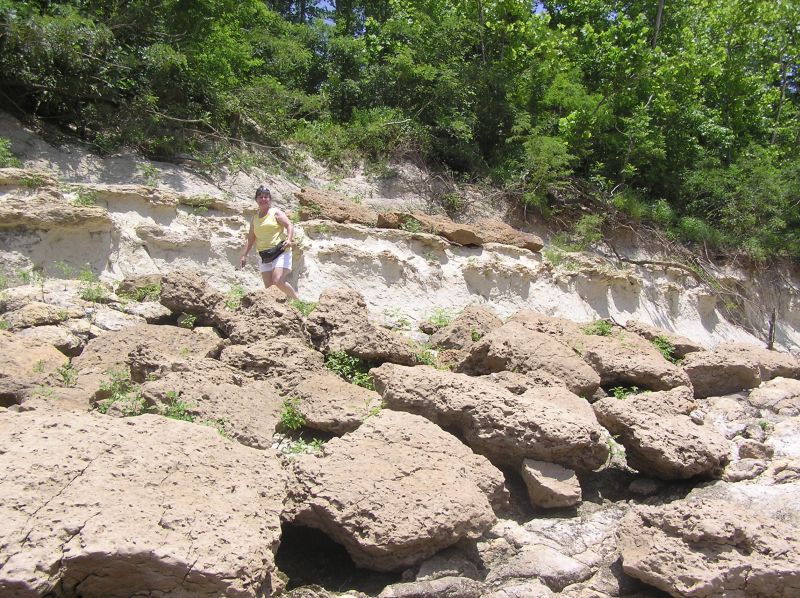
Becky is looking high . . .
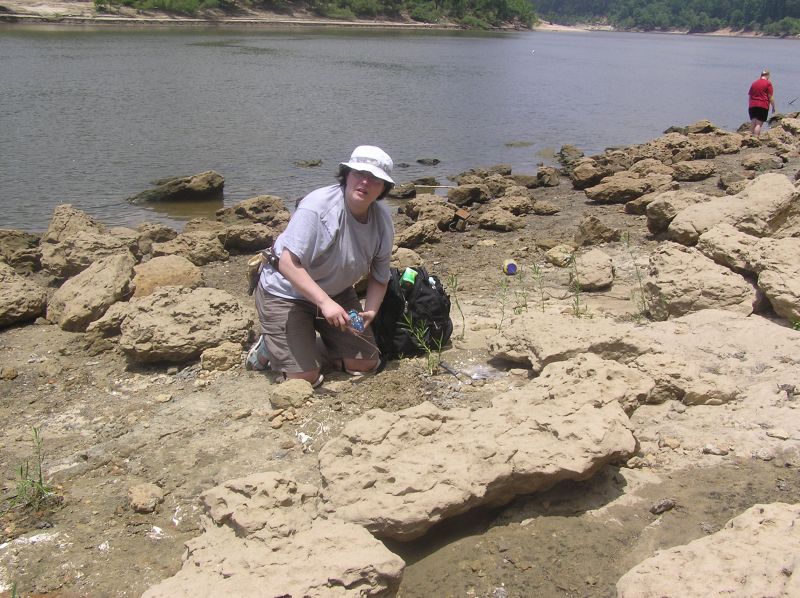
and Anca is looking low!
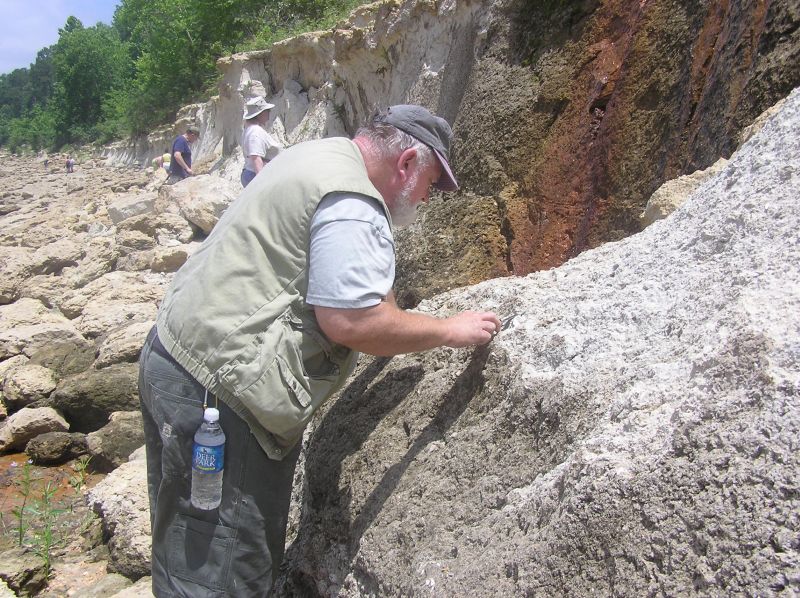
Greg carefully easing out a small coral.
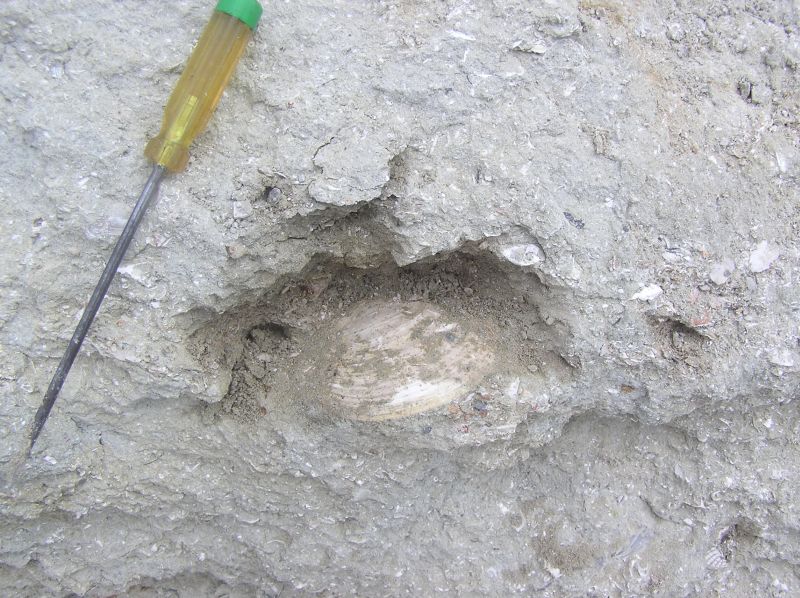
A nice bivalve found by Vicki.
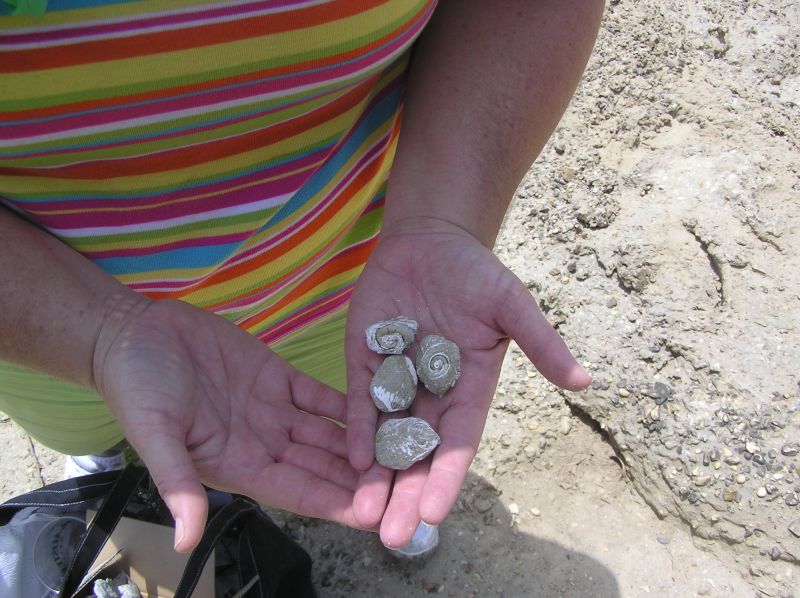
Nice gastropods found by Leisa.
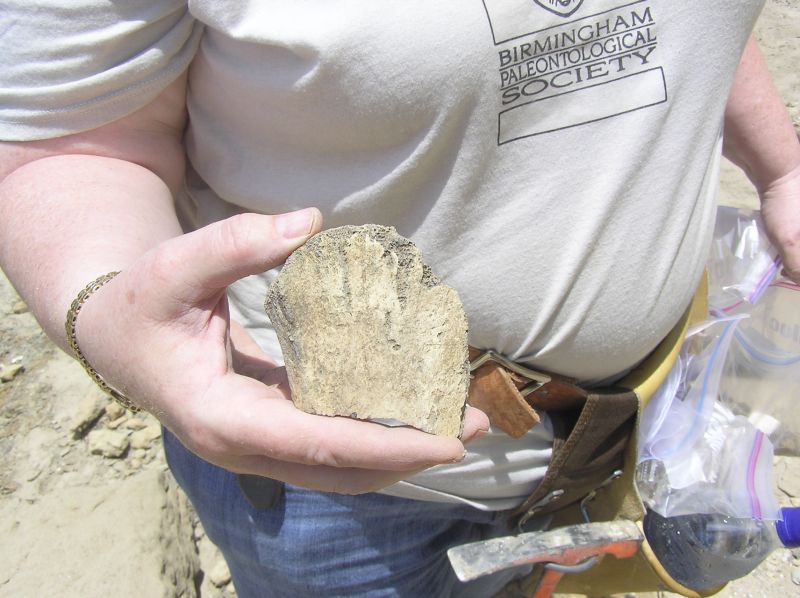
A large piece of bone found by Martha. According to James Lamb, it appears to be another bone fragment from an early whale found in this area. This specimen has been sent to an early whale expert for study.
David is heading to another location. The corals and shells were found from the bluffs to the waterline, while Steve engages in his favorite activity, getting wet!
Jan, look over here!
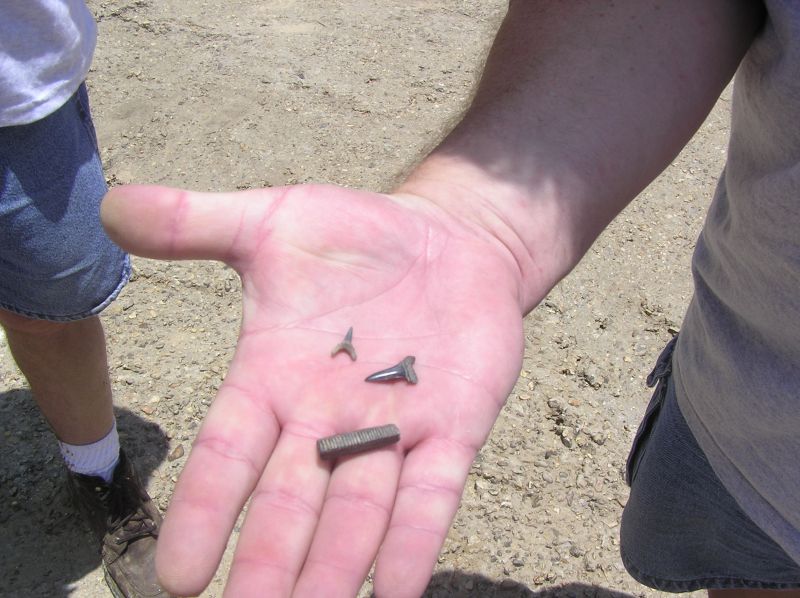
Shark teeth and a ray "tooth".
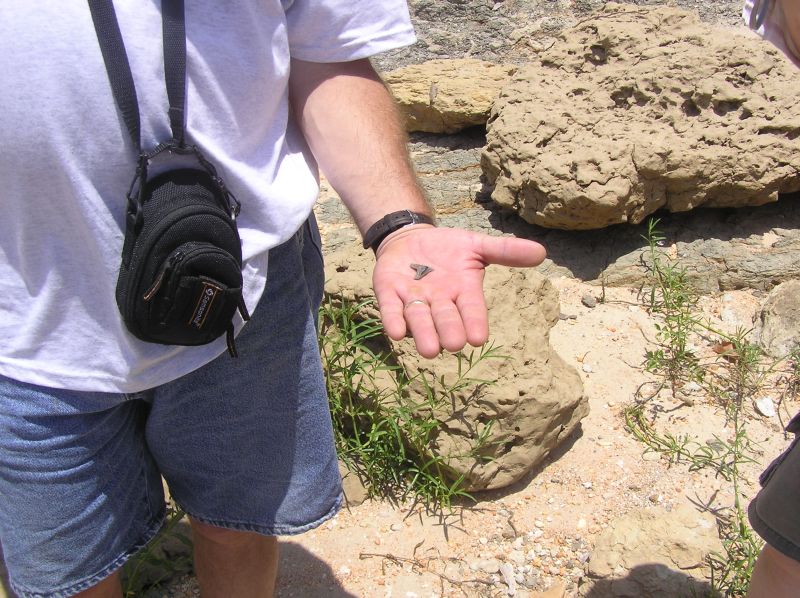
A nice larger shark tooth found by Steve.
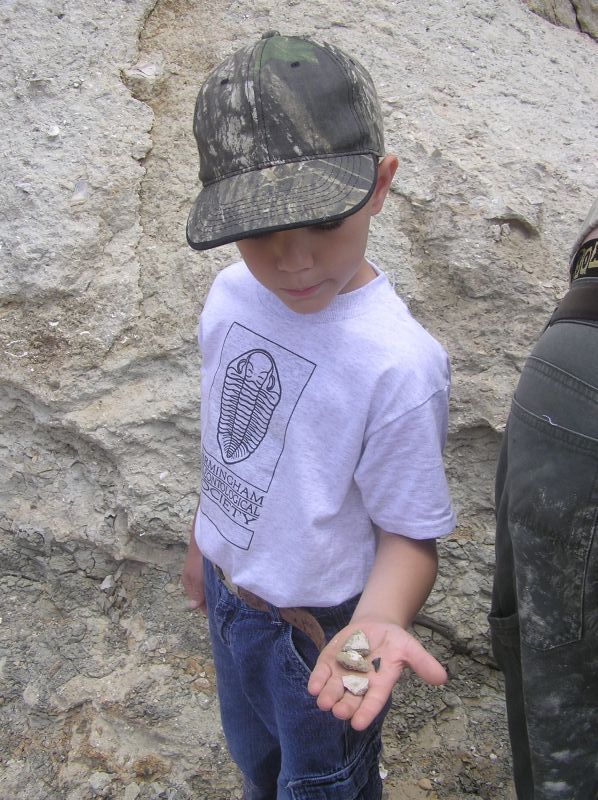
Steven has found coral and a shark tooth.
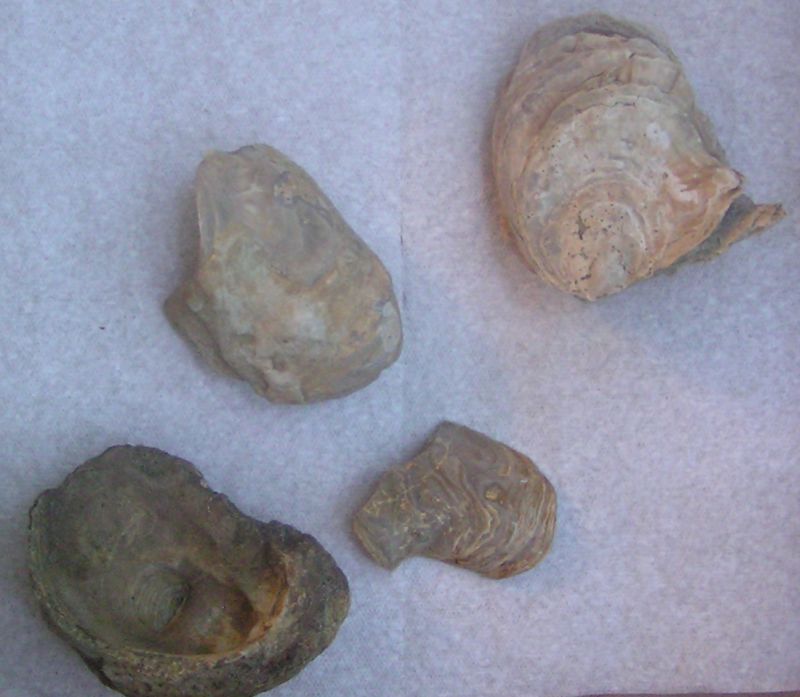
Some shells found by Vicki.
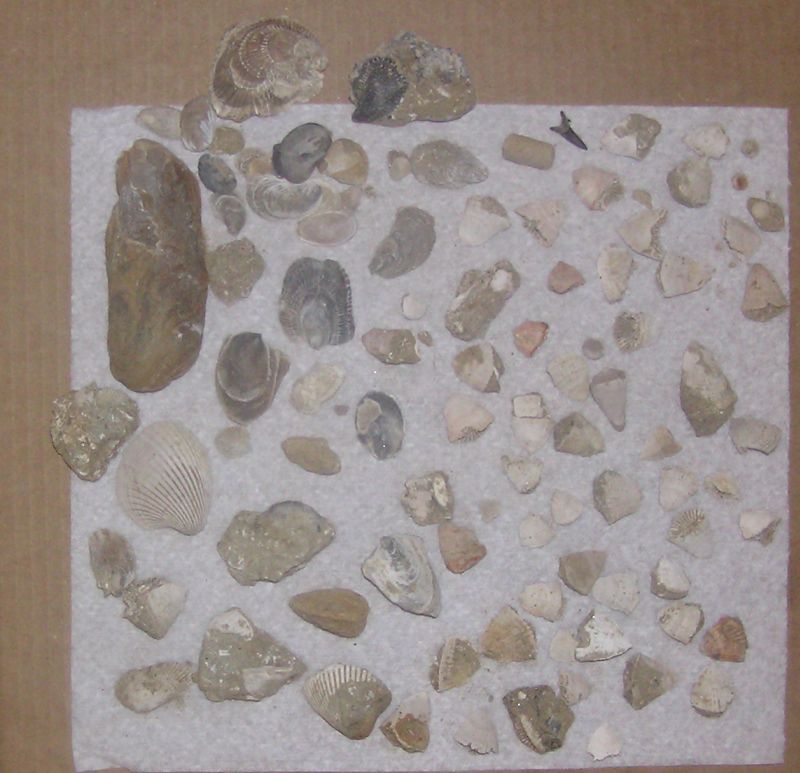
Shells and corals in Vicki's bag.
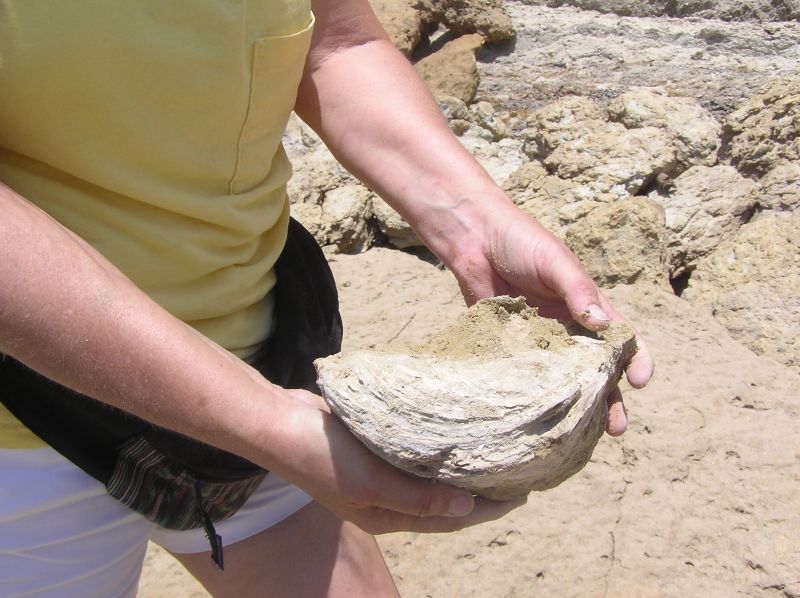
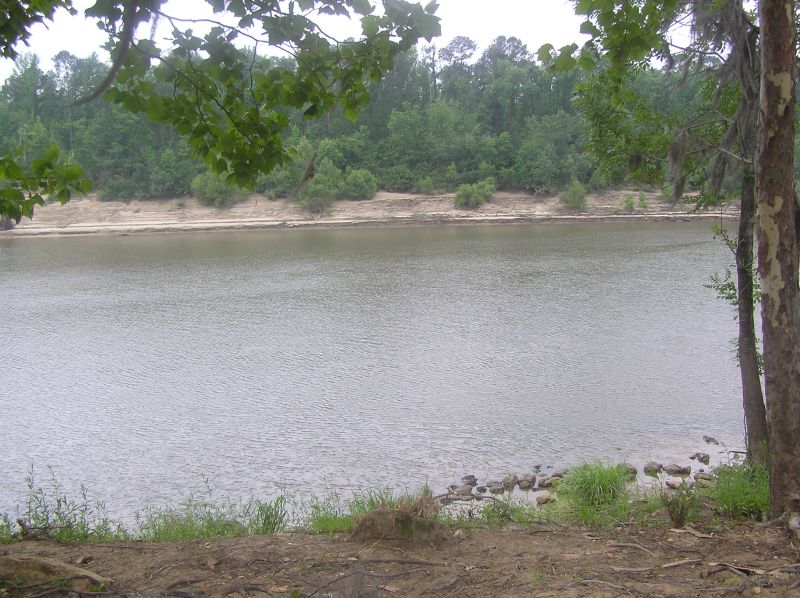
One last look at the river before we head for lunch, then on to the next site.
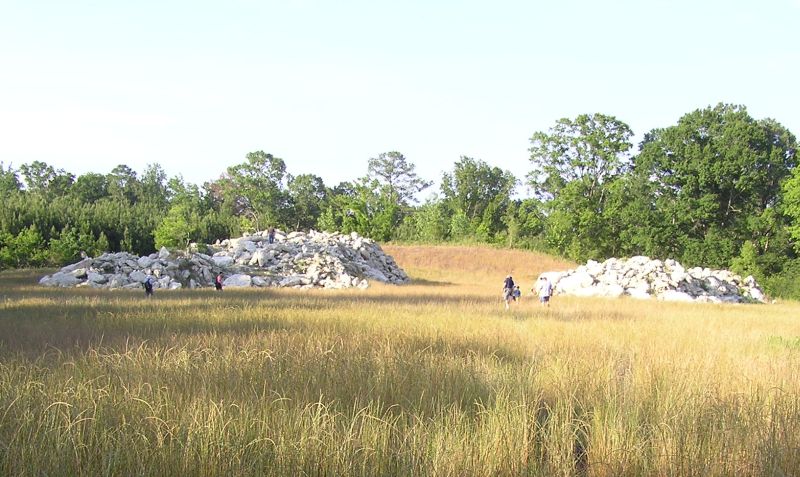
Later in the afternoon we headed north to Wilcox county, to this pile of rocks from nearby road construction.
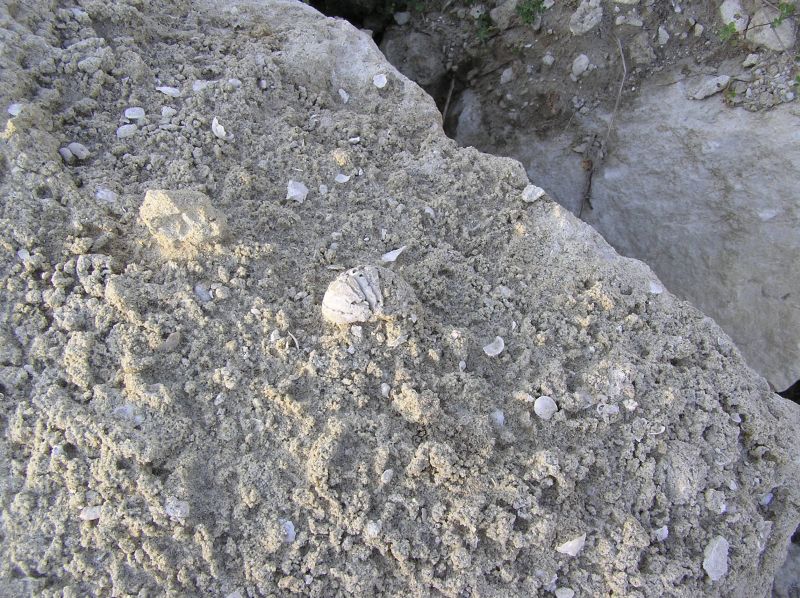
This was spotted on the way in, but the rock was too hard to easily remove the fossil.
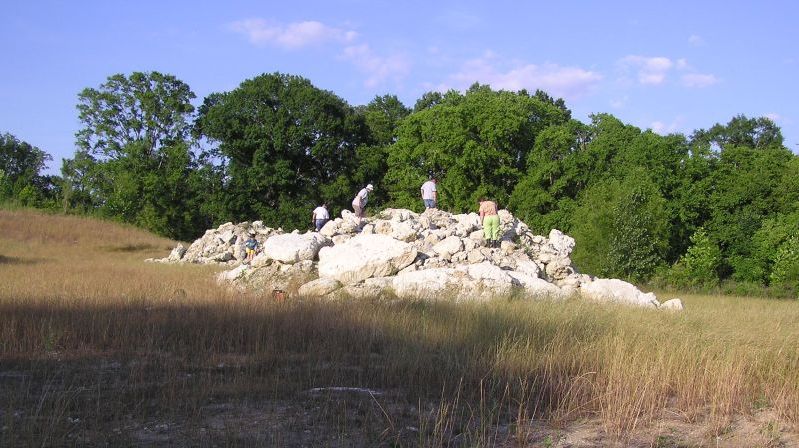
Jan and Lea headed over to this pile of rocks where they found . . .
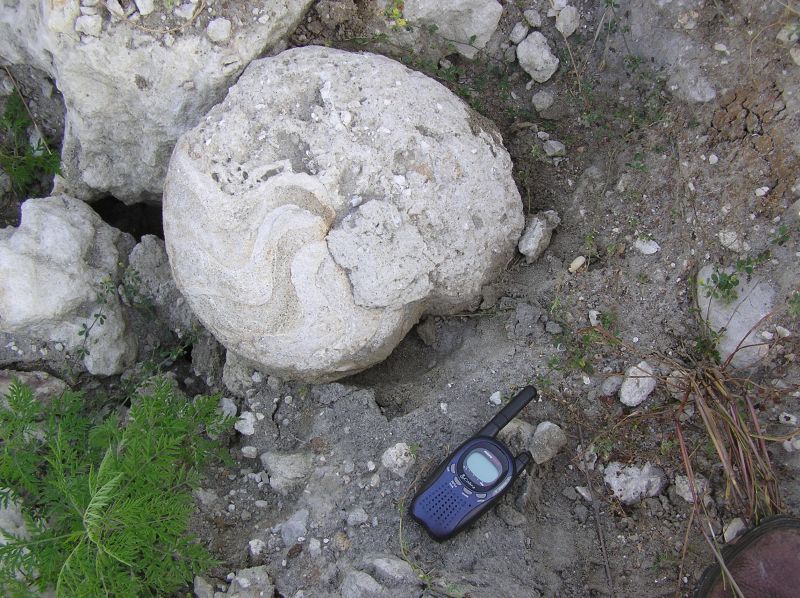
a cast of a very large nautiloid!
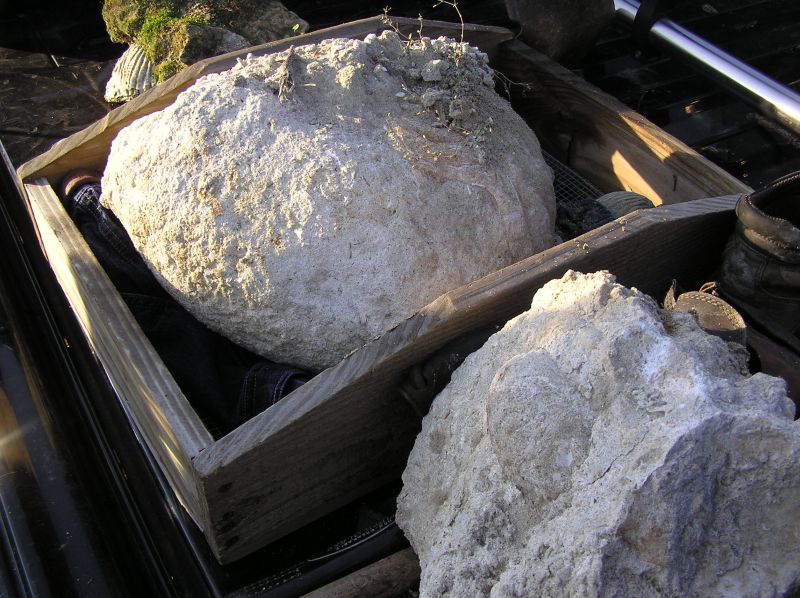
More nautiloid casts.
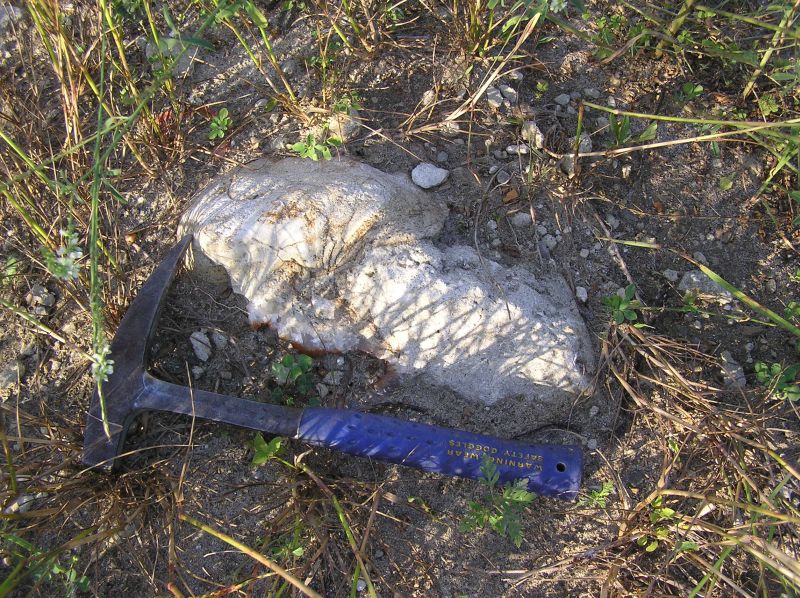
Claire found this piece of nautiloid barely out of the ground. She dug quite a while to work it loose.
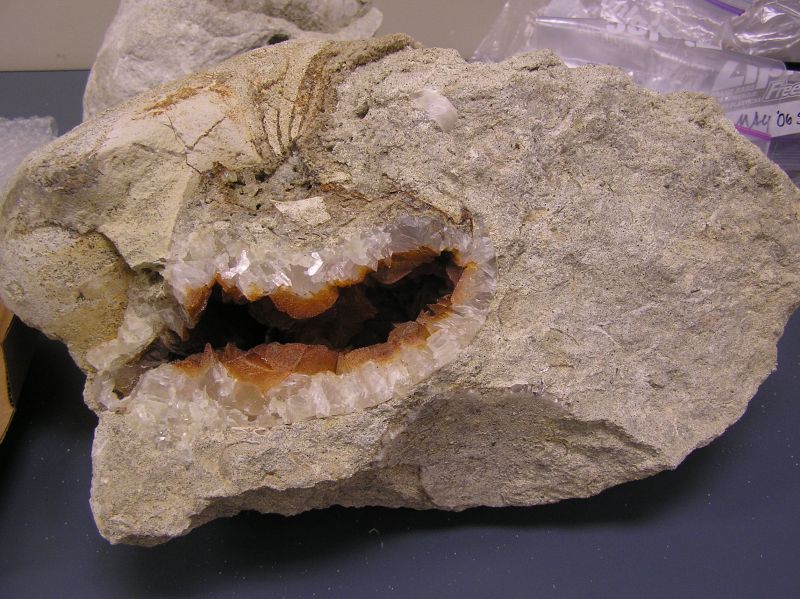
This is what Claire found inside the nautiloid after removing the matrix. Beautiful quartz crystals!
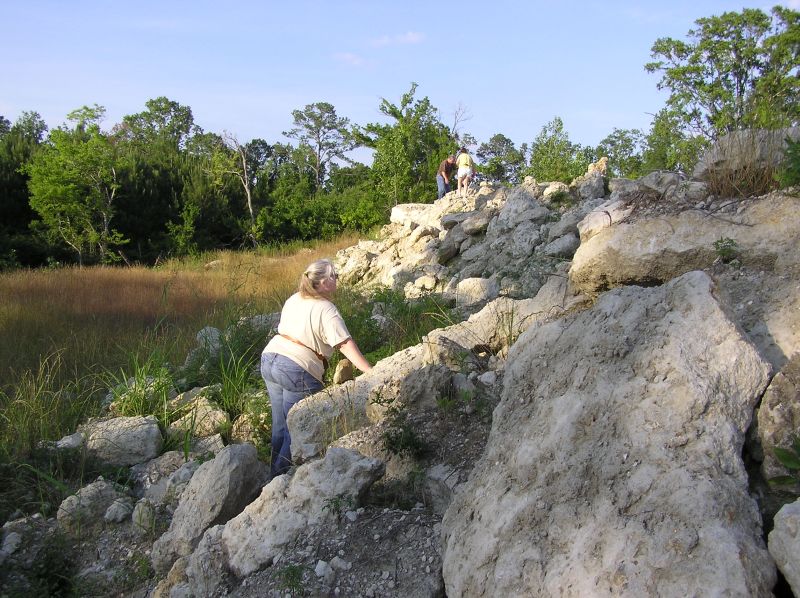
Martha searching for an easy way up, which required the skills of a mountain goat!
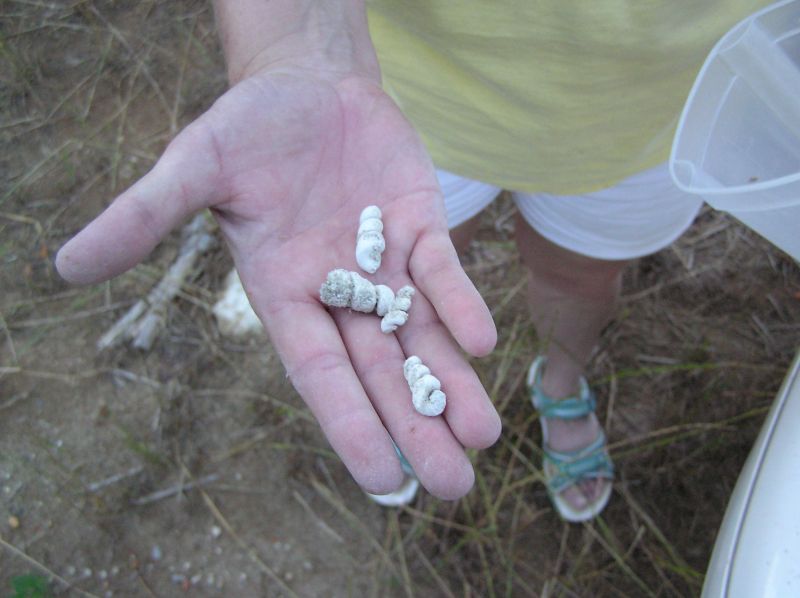
Becky has found some nice gastropods.
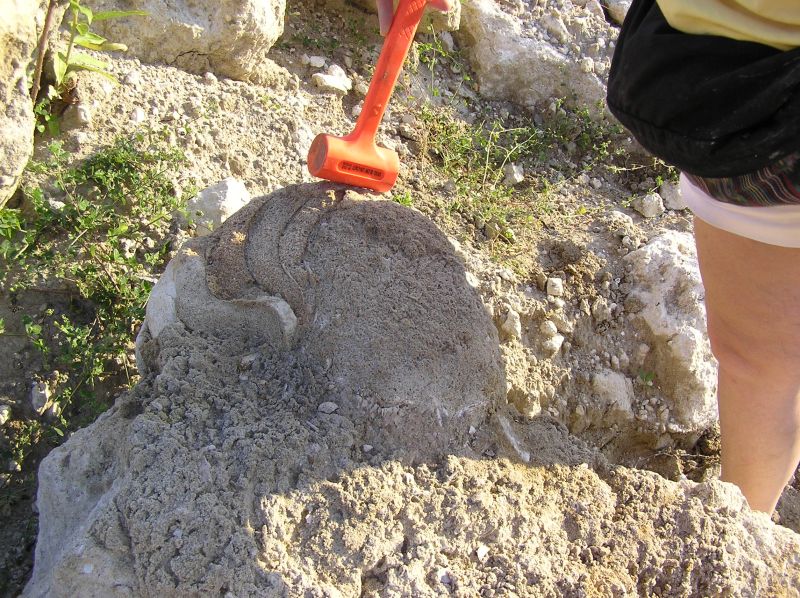
And a large nautiloid cast in extremely hard rock!
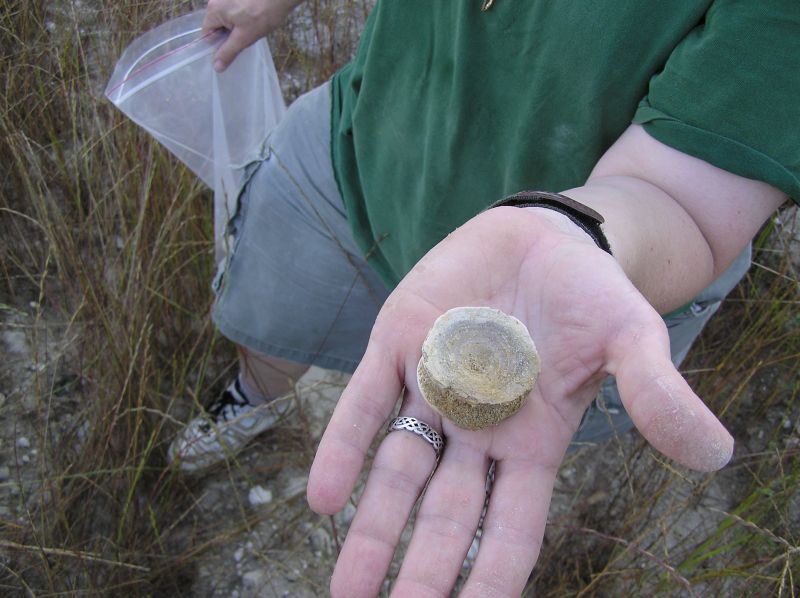
Claire had a very nice day. In a wash near the nautiloid filled with crystals, she found this large vertebra.
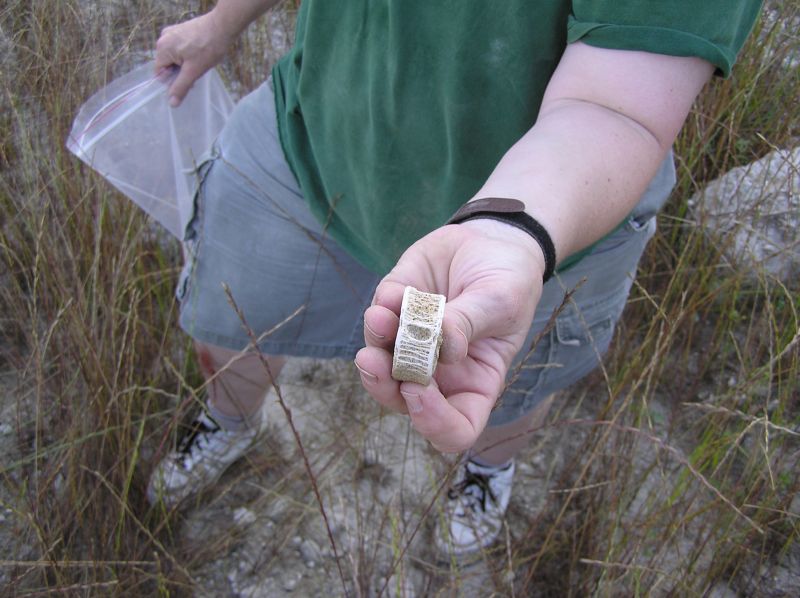
Side view of the vertebra.
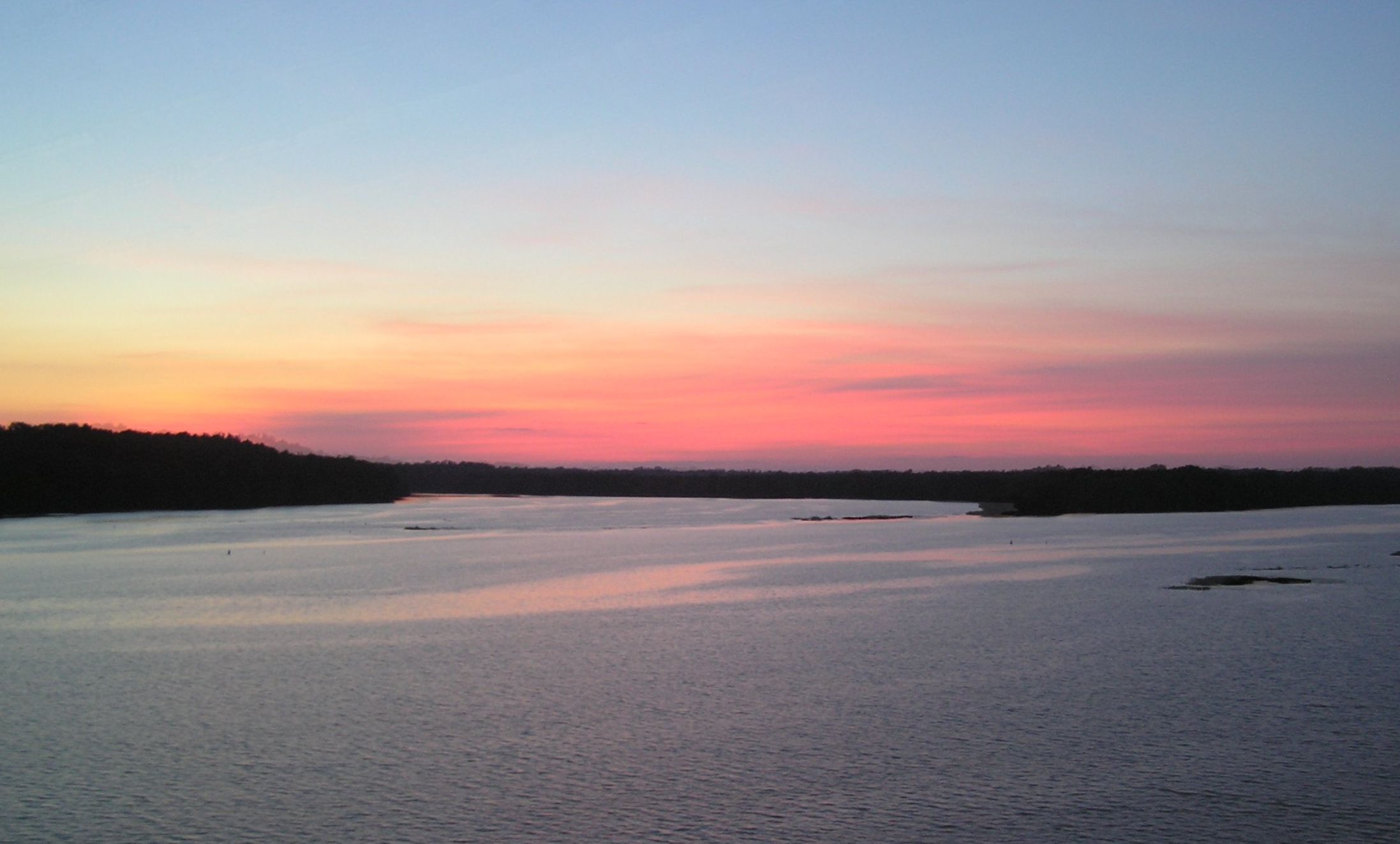
As the die-hard fossil hounds called it a day, we were treated to a beautiful sunset!
July 31, 2004 - Monroe Co, AL
This month BPS members headed to Monroe County in South Alabama, where we collected in the Lisbon Formation and Gosport Sand. Steve and Gilbert took their boats, so we spent the day scouting several miles along the riverbanks. Due to rain earlier in the week, the water level had risen 6-8 feet since the scouting trip, so the ledges were mostly underwater, and our collecting was restricted to the upper reaches. Numerous gastropods, turritella and trace fossils that appear to be burrows of some kind were found, also a few shark teeth, echinoids, and even a piece of permineralized wood were found. Some of the bivalves were complete and hardened. Many of the turritella and other shells found in the Gosport Sand were so fragile that it took careful digging to keep the shells from dissolving as they were touched. When broken open, a number of the "burrows" had shells inside them. Wildlife was also spotted, including an alligator and alligator tracks, numerous herons, and Steve spotted the largest water moccasin he had ever seen in his many years in the outdoors, startled him so much he threw his fossils in the river beating a path back to the boat! Sorry 'bout that, Steve!
Members participating in this long trip were Greg, Jan, Steve, Leisa, Gilbert, Carolyn, Vicki, Nancy and Miss Daisy.
(Photos courtesy Nancy Kenfield, Steve Corvin, and Vicki Lais)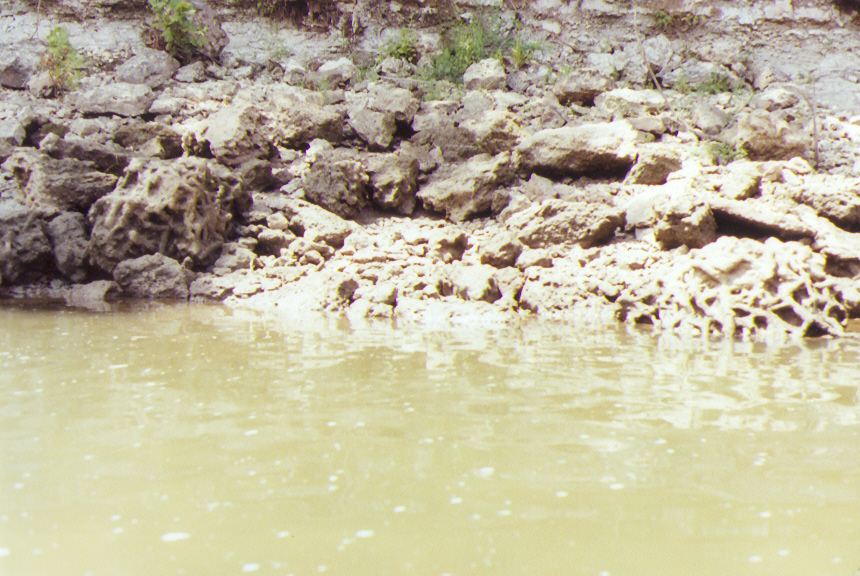
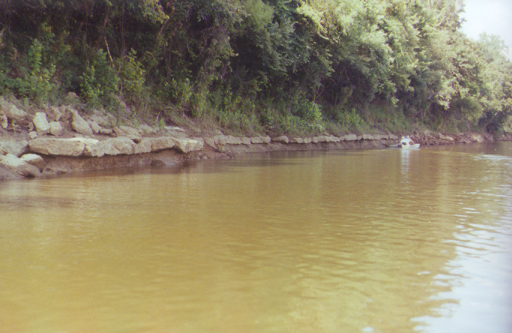
Along the shoreline.
Greg and Steve, getting ready to check out this landing.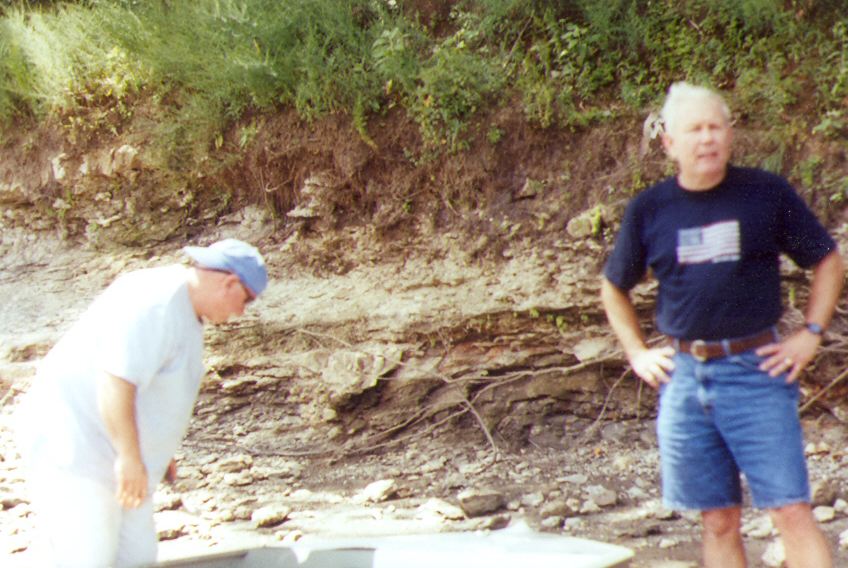
Shells in matrix. Sand is wet, and shells will disintegrate at the slightest touch. Careful excavation is essential.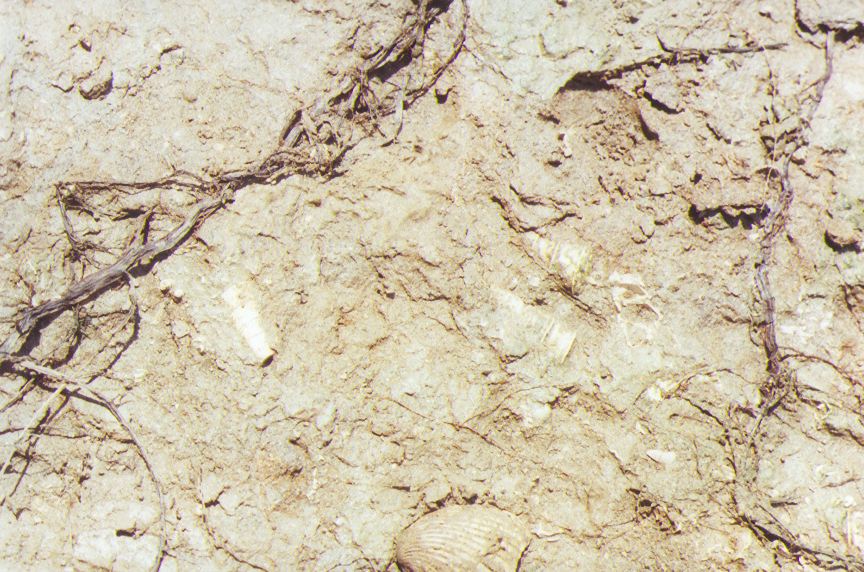
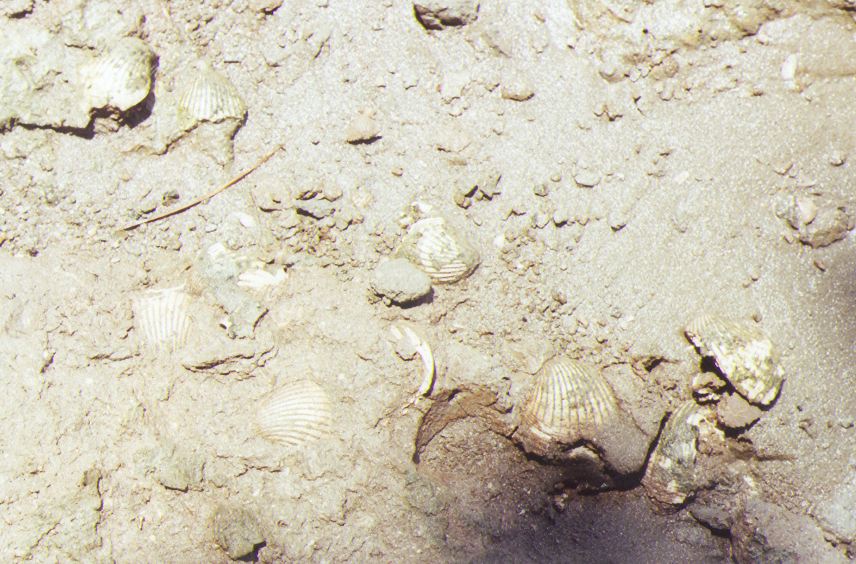
At slightly higher elevations, the shells are dry and hard. Leisa found these.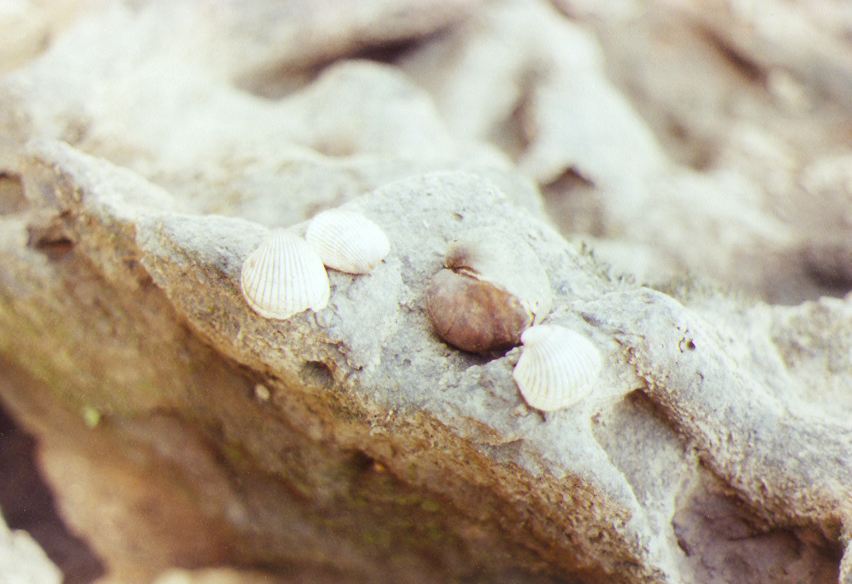
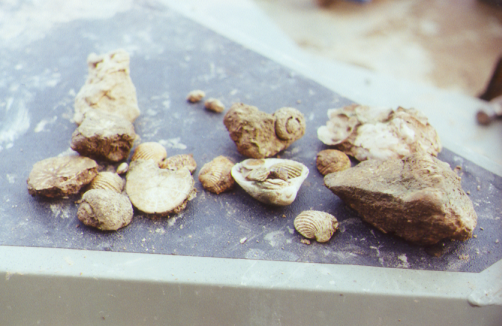
A representative sampling of shells in this locality.
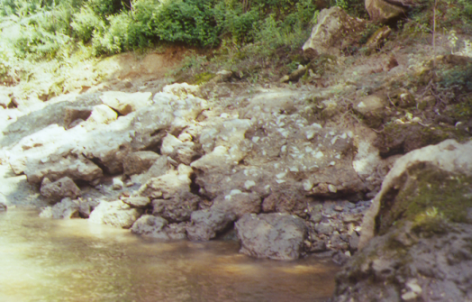
Shell impressions.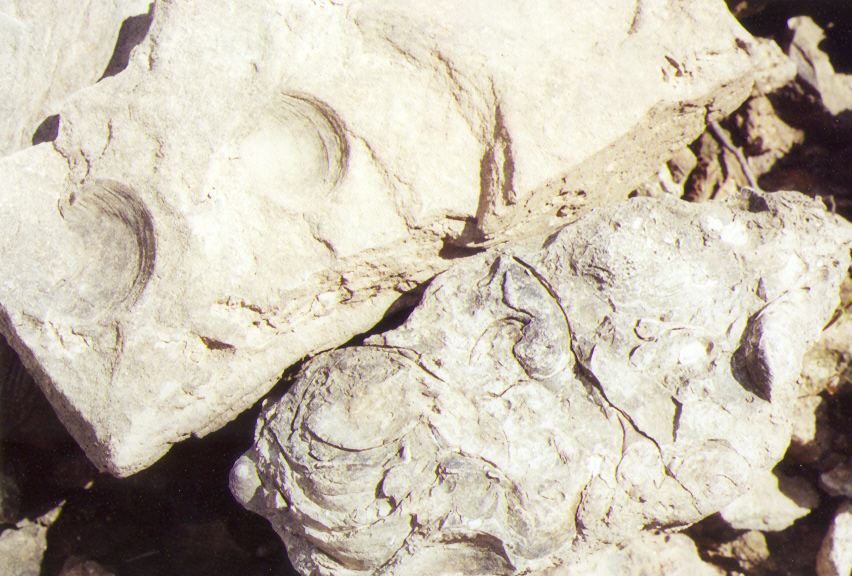
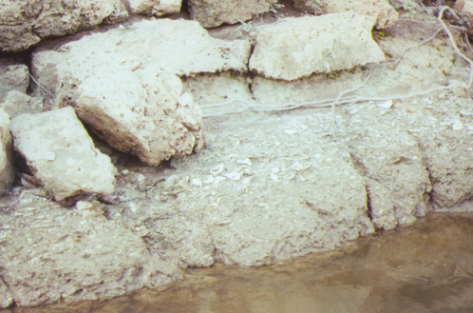
Shell layers in the bank.
Turritella found by Steve.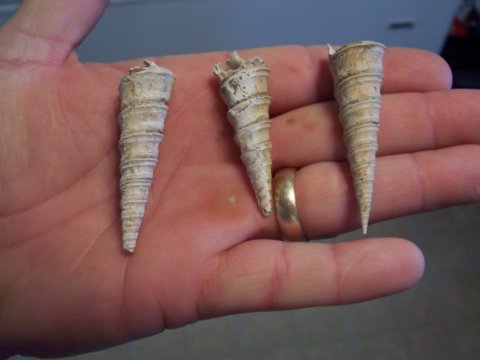
Sand dollar found by Steve.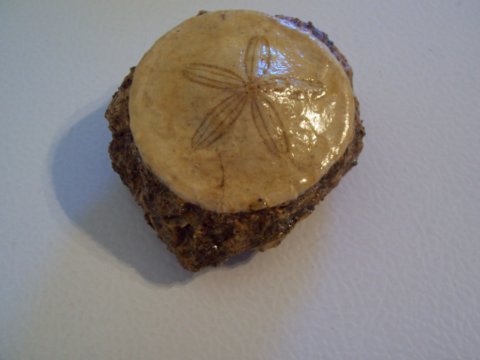
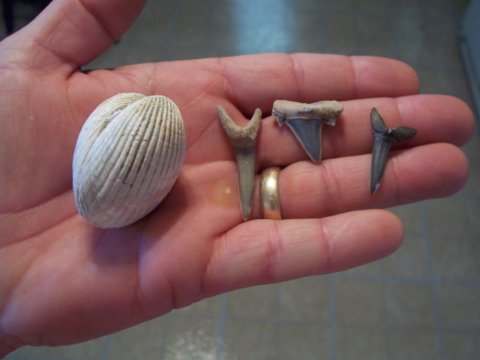
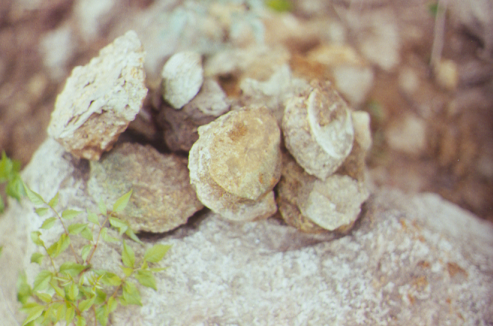
Nice collection of sand dollars found by Steve.
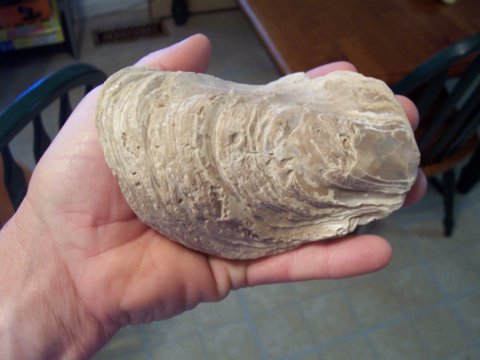
Large boulders, appearing to be trace fossils, perhaps burrows.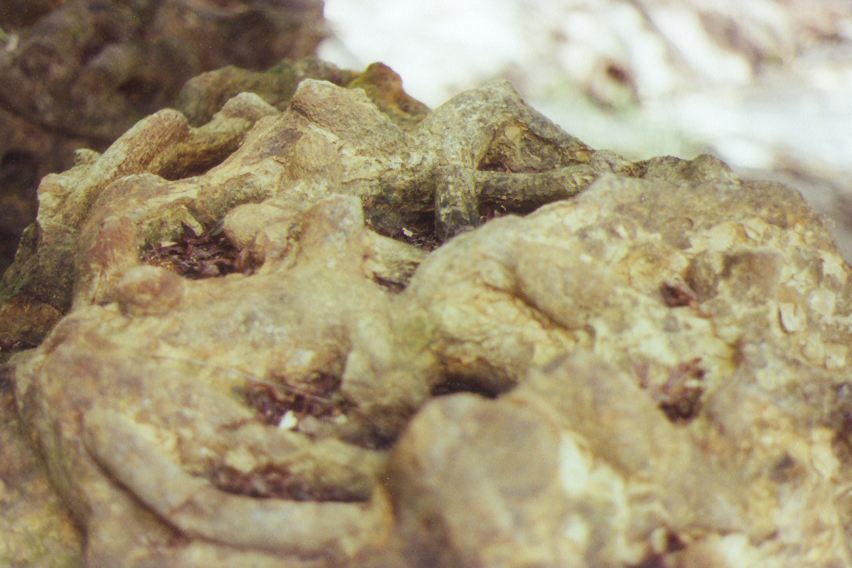
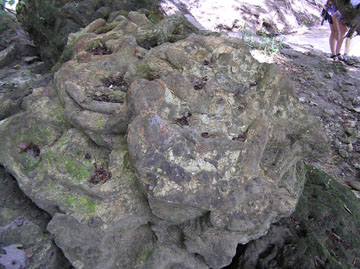
Many of the burrows had shells inside.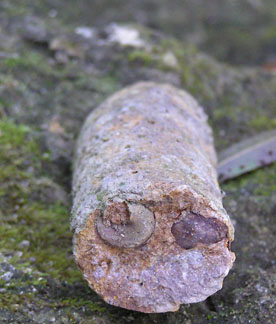
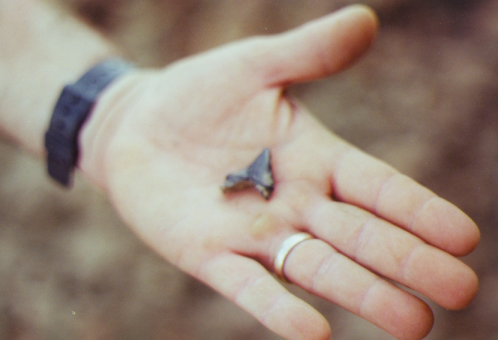
Tooth found by Steve.
Gilbert after a long hard day on the river.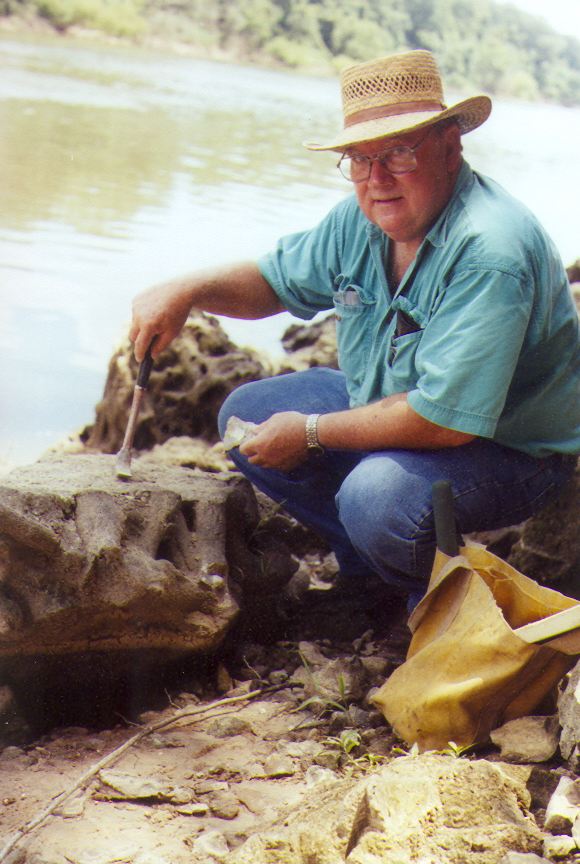
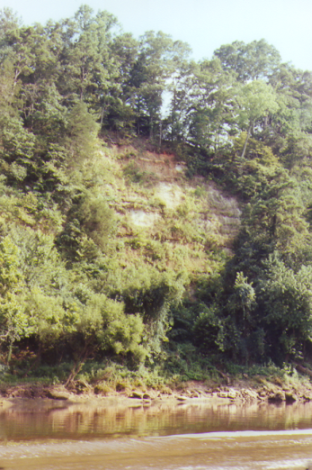
A view of the bluffs, mostly grown over now.
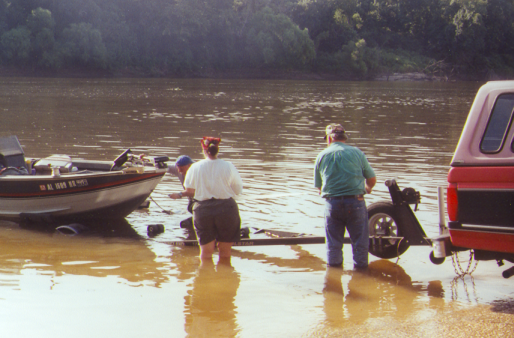
End of another great collecting day!
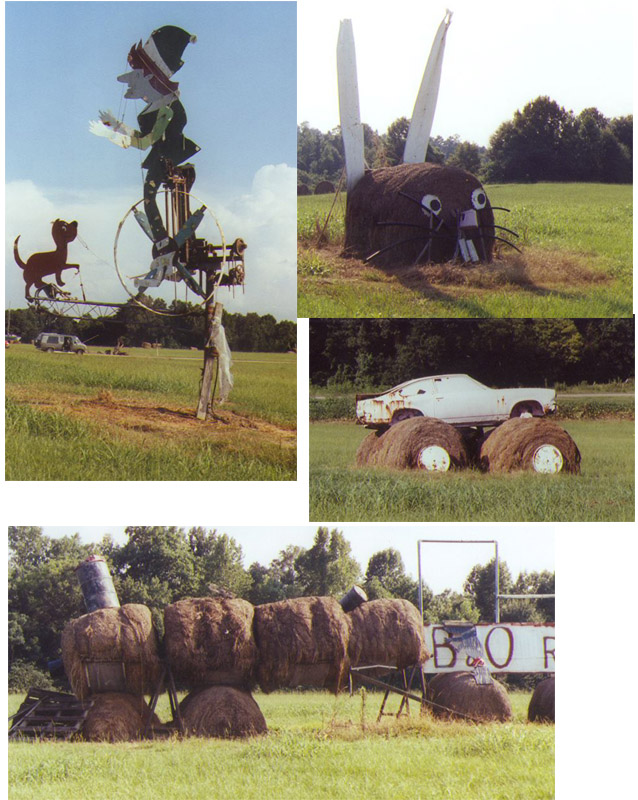
On the way down, some of us apparently took a wrong fork in the road.... that sign was deceiving.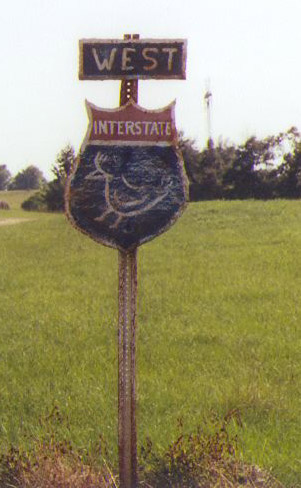
And we entered into a strange land, populated by the most bizzare critters! (Forkland??)
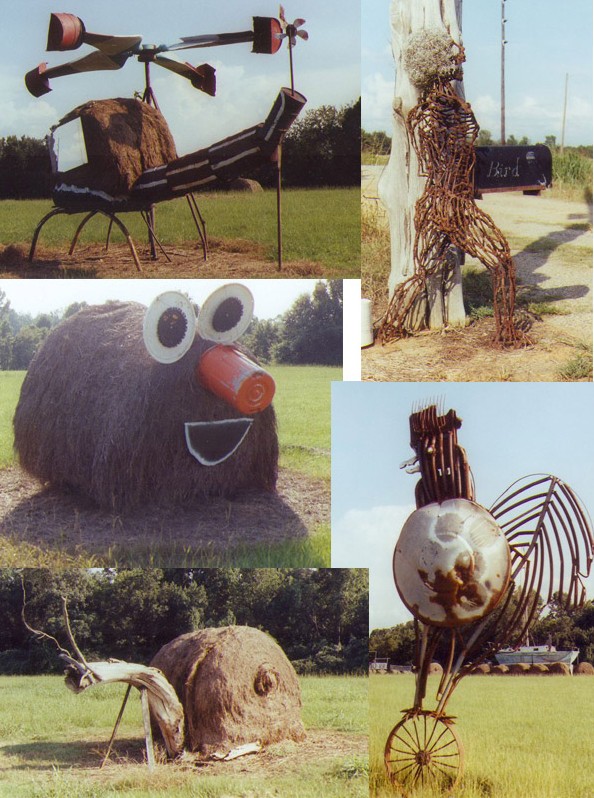
For scale, note that Vicki is hugging the tin man's leg. Both the ship and car (above) are REAL.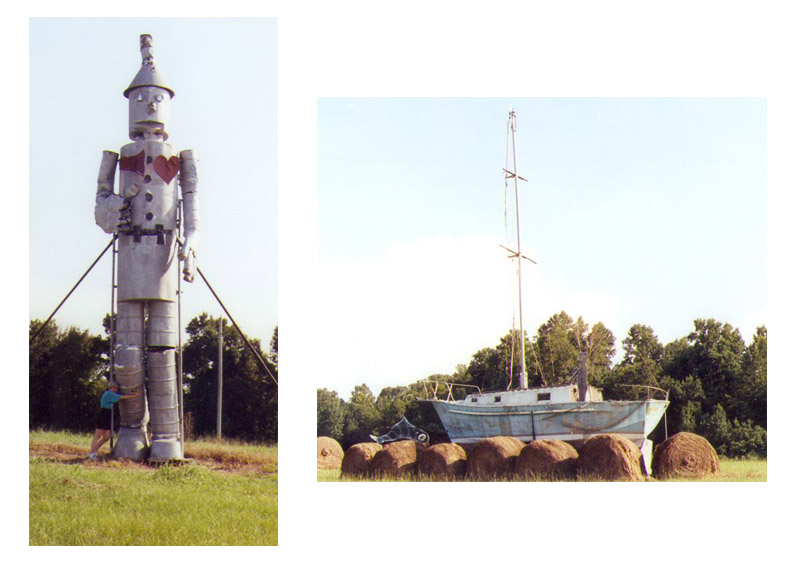
Alabama countryside near Forkland.
August 15,1999 - Covington and Escambia Co, AL
Department of Physics and Astronomy
University of Alabama
Tuscaloosa, Alabama
Edited by Vicki Lais
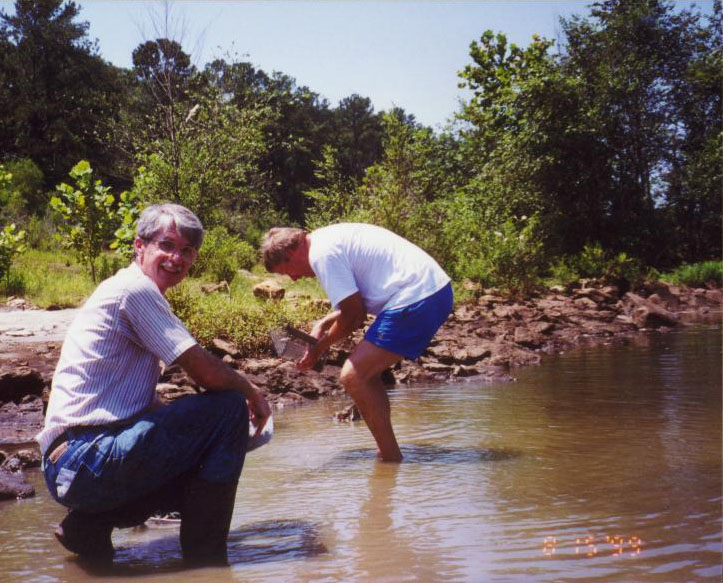
The field trip had two parts. First, we visited a well-known river site in Covington County where shark and ray teeth are present in great abundance, in the lower Tallahatta Formation. Then, we visited a small museum owned by a private collector near Andalusia, in Escambia County. The trip was attended by 20 BPS members and guests on a hot, but not so humid, mostly clear day.
 According to Dr. David C. Kopaska-Merkel of the Geological Survey of Alabama, the lower Tallahatta Formation is early Eocene, or about 50 million years old. He says that the formation is slightly younger than the famous Bashi Marl shell bed, and older than the even more famous Gosport Sand shell bed.
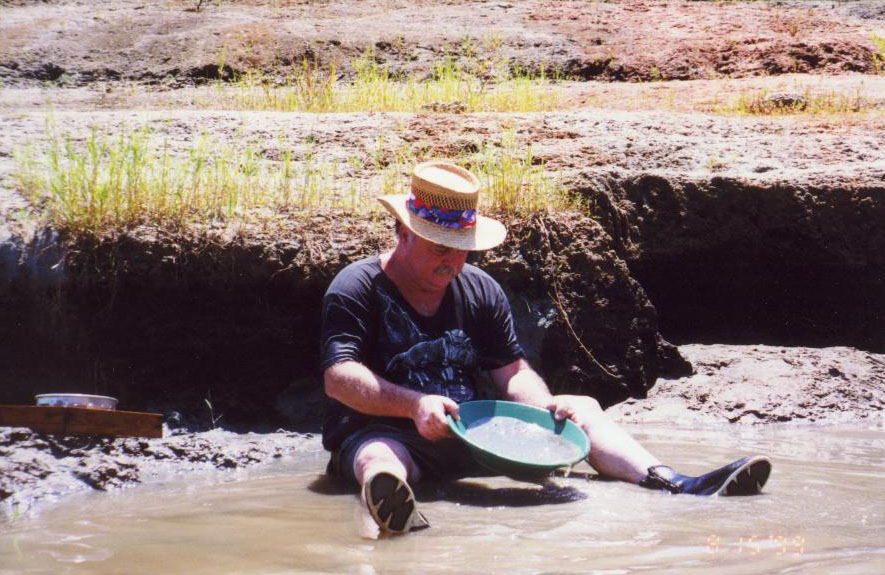
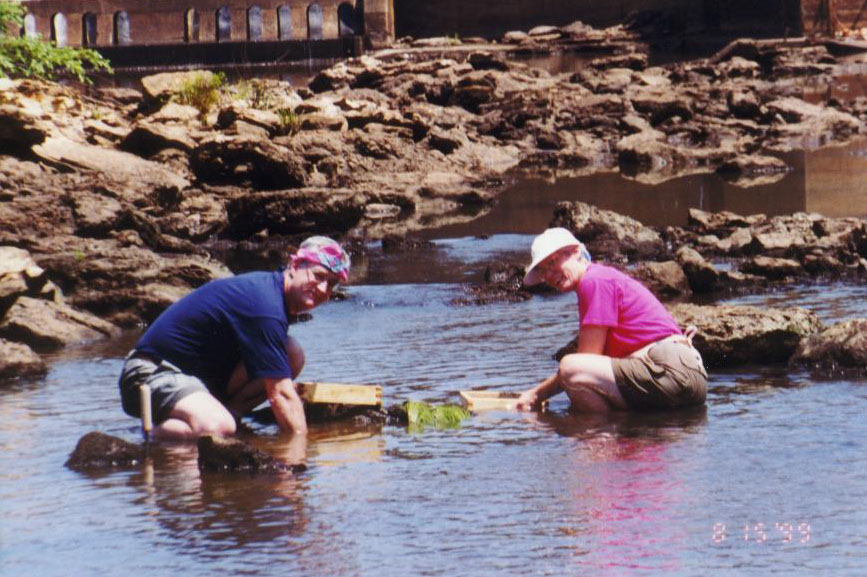
The site is a well-known collectors area that was visited by the BPS previously in August 1998. The site has mostly shark and ray teeth preserved in a gray sand on the bank of the Conecuh river. The area has been visited so much that large holes pocked the bank where people had previously searched. Apparently, there is some commercial interest in the area, with people digging for large teeth for jewelry to sell, and leaving the smaller items in "spoil piles" of mud. Many of the attendees searched these piles with some success.
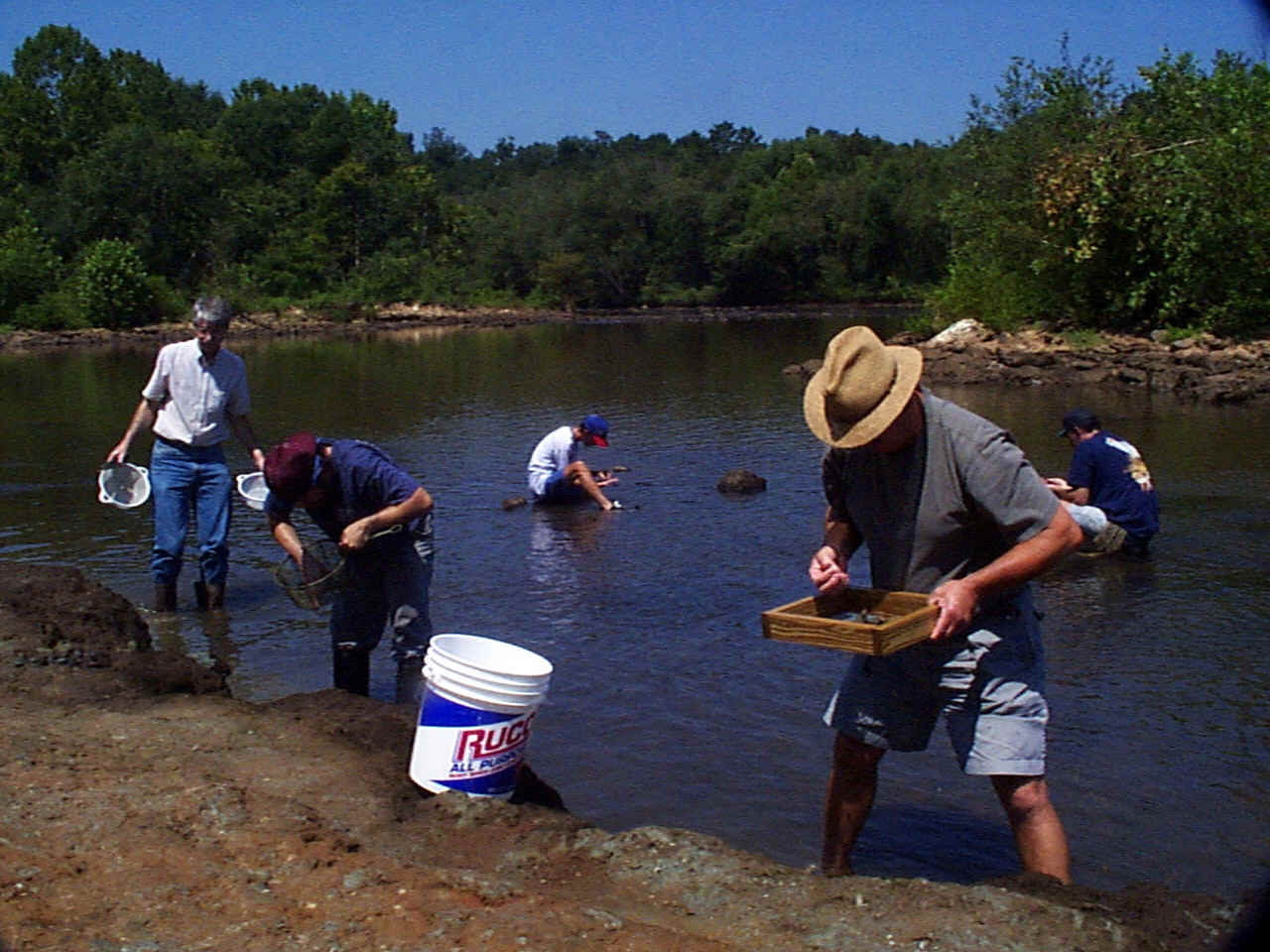 The most abundant fossils seemed to be teeth of sharks, with perhaps up to 11 species represented according to one collector, who told me that he visited the area about 3 times a month.
Dave Kopaska-Merkel told me that he found teeth of tiger sharks and at least 3 other kinds at this site, and saw a 5th kind. Most of the teeth I found seemed to be of the upper jaw variety, where there is a single broad cusp, at least two smaller accessory cusps, and a broad, symmetric root with a dip in the middle. These upper teeth are distinct from those of the lower jaw, which have a longer, narrower primary cusp, clear narrow ridges along this cusp, and a somewhat U-shaped root. No significant accessory cusps are usually seen on these teeth. I noticed that while most of these lower jaw teeth were black, some were actually light brown in color.
These are probably weathered examples, and often were missing part of the U-shaped root.
Next to the shark teeth, the most abundant teeth were those of rays. Unlike the shark teeth, which are also abundant at late Cretaceous sites in Greene County, the ray teeth seem to favor the Eocene site. On asking Dave Kopaska-Merkel about the difference, he offered the following speculation:
"I think most rays are bottom dwellers in shallow water, so if the Greene County site represents a relatively deep water deposit, then there might be relatively few ray teeth there. Also, I think ray teeth are slightly more fragile than shark teeth."
I am not sure what type of rays had the teeth we all found. Most of the ray teeth are elongated rectangles with narrow parallel ridges cut perpendicular to the long axis. At least one ray tooth that I found was notably curved.
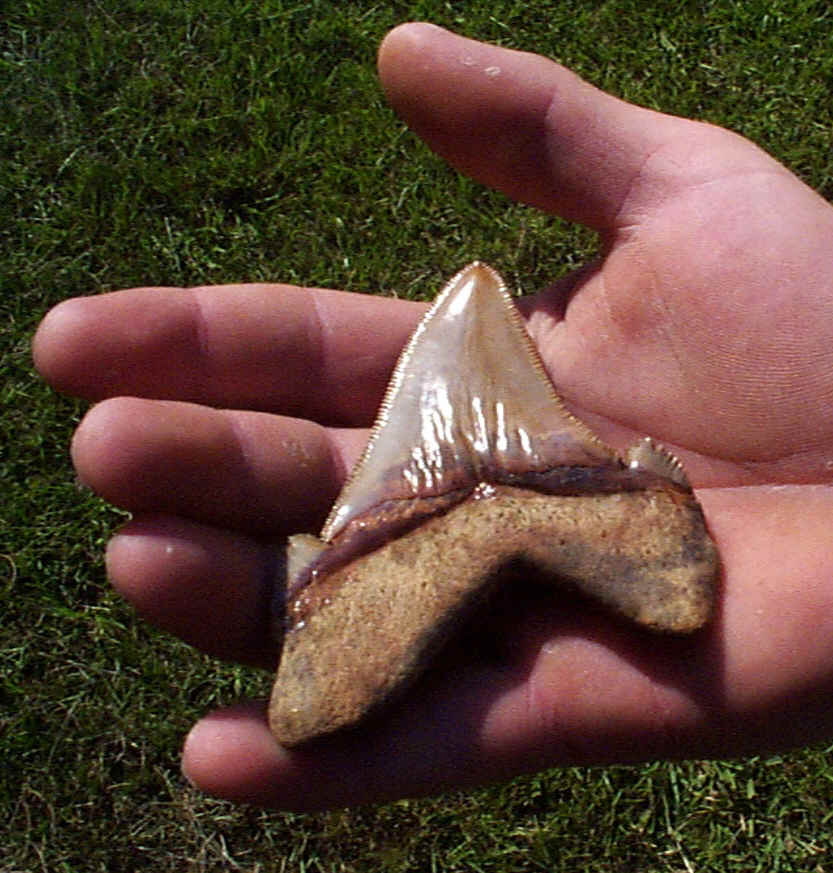
Certainly other types of fossils are represented among the hundreds of items people have been finding at this site. One attendee showed me what I think was a small part of a turtle shell, and several likely fish vertebrae were found, one with fragile stems still connected. Bone fragments, sawfish spines, and shark vertebrae were also found, the latter being distinctly circular and somewhat concave-shaped. Some fragile coral specimens were found that came from points higher up on the embankment, which exhibited abundant well-preserved burrows, according to Dave Kopaska-Merkel.
The high point of this field trip was without a doubt the BPS's visit to view the collection of shark teeth, marine organisms, marine mammal bones, and ice age fossils owned by Mr. Hoomes, a local contact.
Mr. Hoomes is an example of someone who developed a 21-year long interest in fossil collecting after a chance encounter with an unfriendly shark tooth in a creek near his parents home when he was 7 years old. While ambling around in the creek, he stepped on something sharp and thought he had cut himself on some glass. It turned out that he had stepped on an ancient shark's tooth, about one-half to one-inch long, that was standing roughly upright in the creek. (He now wears this tooth on a trademark hat.) He later did more exploring and discovered that shark teeth and other items had a habit of collecting into "potholes" around limestone embankments, and he became very good at recognizing the right places to look for such things. In two of his display cases, he had dozens of large shark teeth beyond anything which most of us had ever seen. To say it was merely an impressive collection of such teeth would be an understatement. Mr. Hoomes also had on display large whale vertebrae and jaw bones, probably from the same period as the sharks teeth.
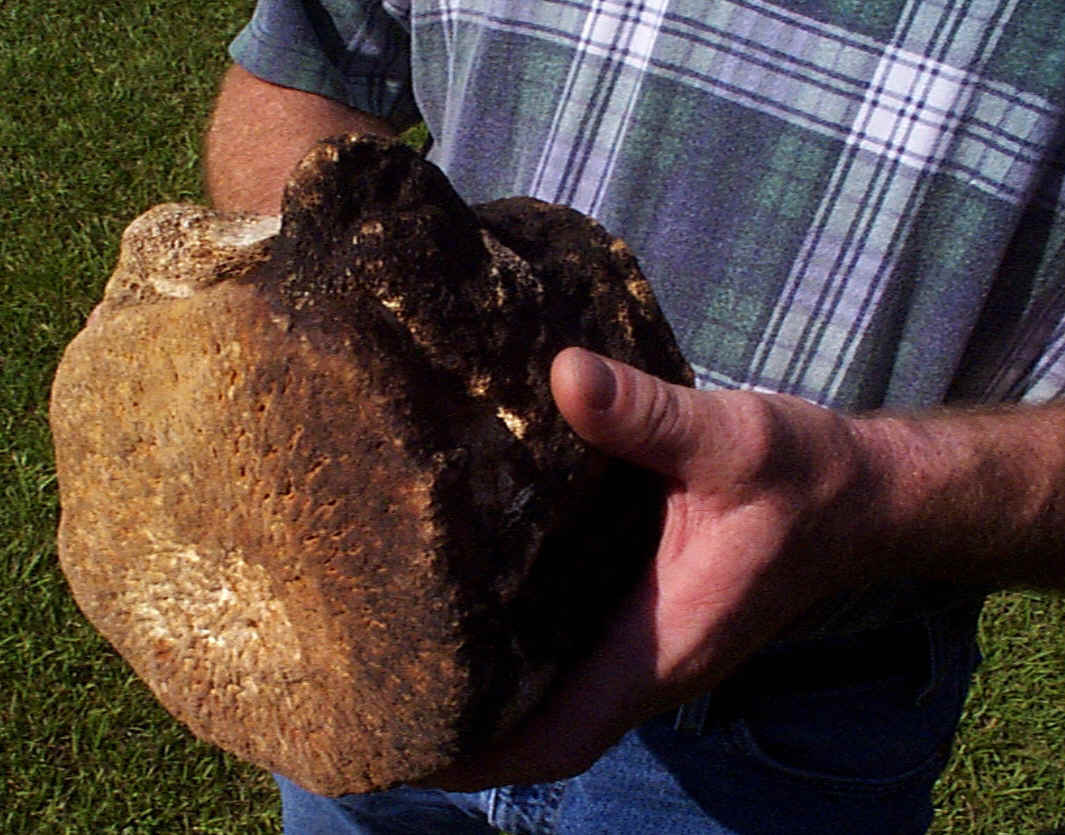
Especially interesting were Mr. Hoomes's ice age fossils. A humpless camel tooth, bison fossils, horse teeth, and many other items lined his many shelves. Mr. Hoomes also related to us his discovery of bones and stone implements at a likely "kill site" where early humans attacked and killed a mammoth. He showed us artifacts in the form of triangular bone fragments which had been made into likely primitive weapons by the ancient people of the area.
Mr Hoomes said he has explored many of the rivers within a five-county area around his home and his vast experience clearly showed in the things he told us.
His collecting has gone beyond what most of us do, and has included searches in remote creeks, not-easily-accessible embankments, and occasional encounters with alligators!
In summary, this was again an excellent field trip for the BPS. Thanks to James Lowery for arranging the trip, and thanks to Mr. Hoomes for taking us on a fascinating journey into Alabama's past! Thanks also to Dave Kopaska-Merkel of the GSA for his comments on this report, which improved its accuracy, and to Jim Lacefield for supplying all of the above images.
Following photos courtesy Larry Hensley.
|
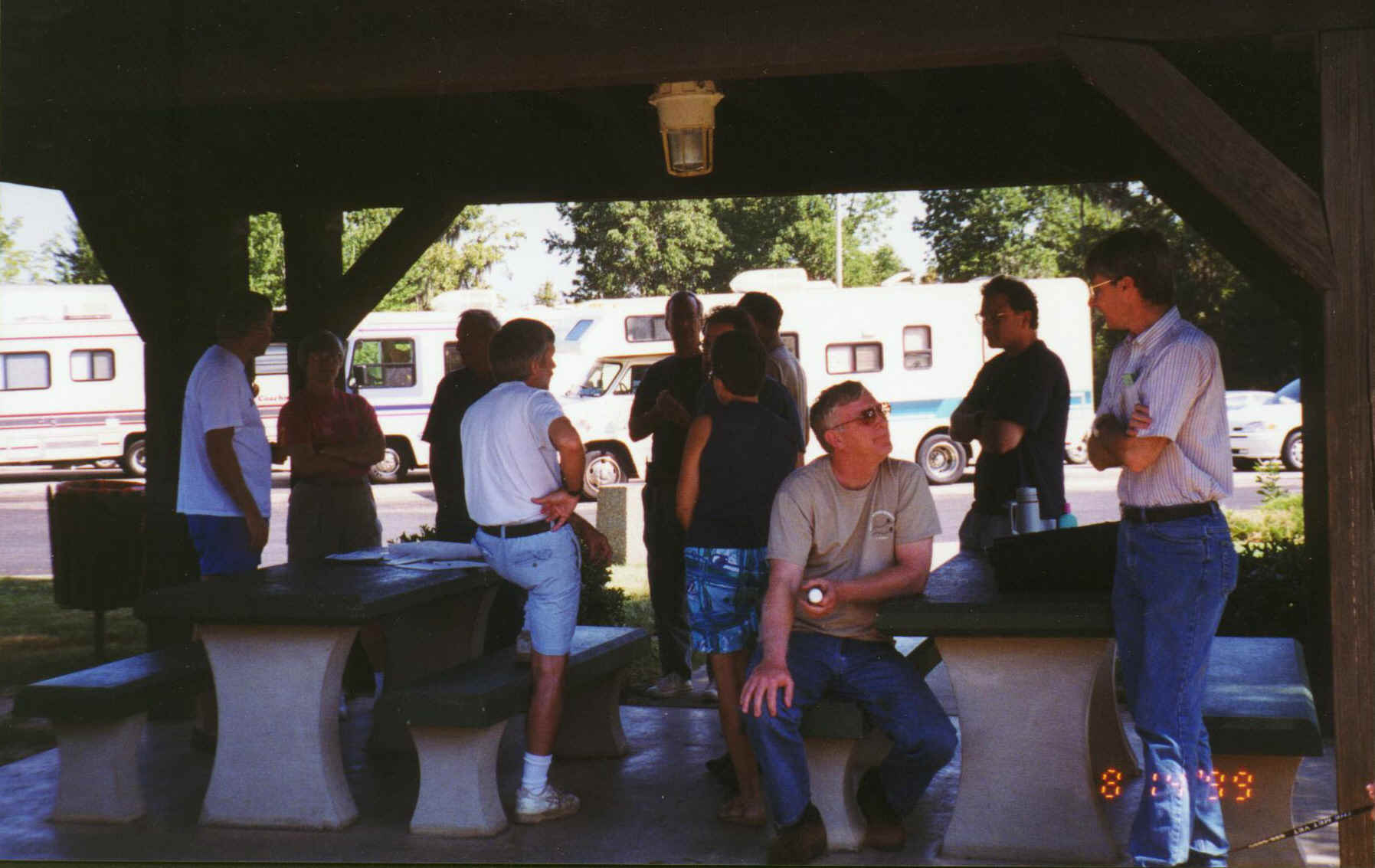
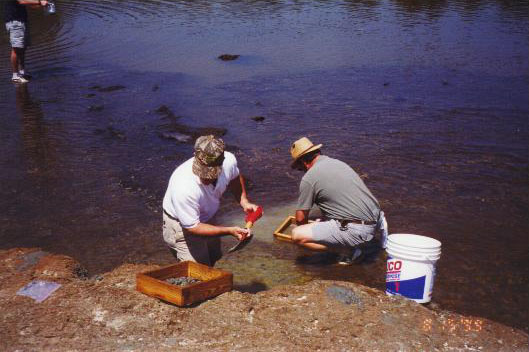
The three people in the foreground are James Lowery with his back to the camera, Jim Lacefield, seated, and Ron Buta, arms folded and deep in a serious discussion of paleontology. |
|
|
|
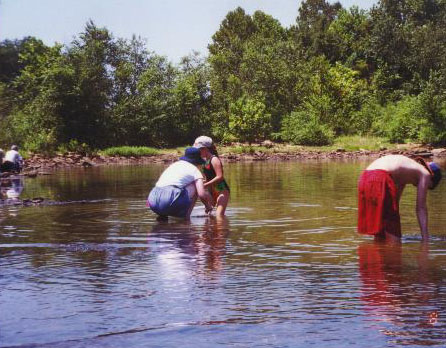
The Hensley Family |
|
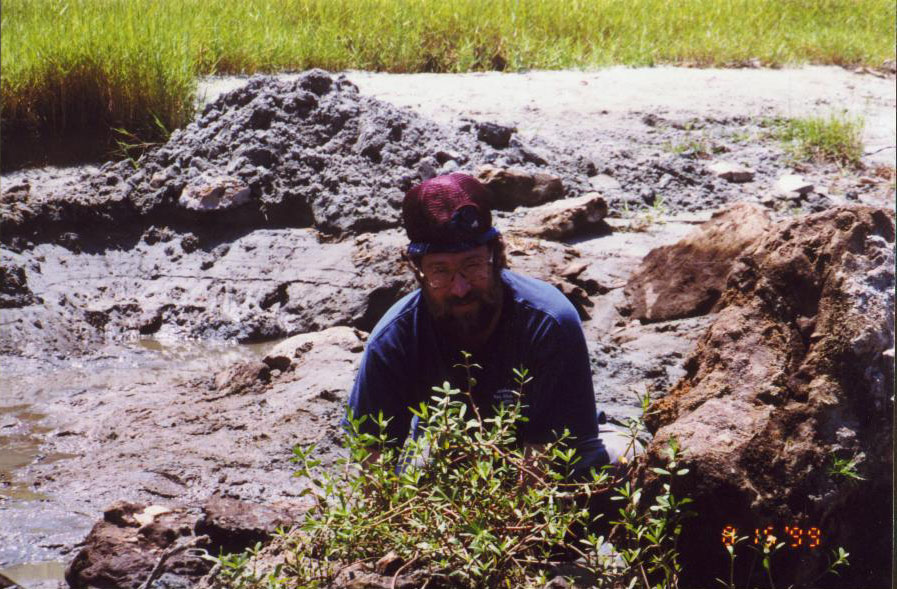
David Kopaska-Merkel |
|
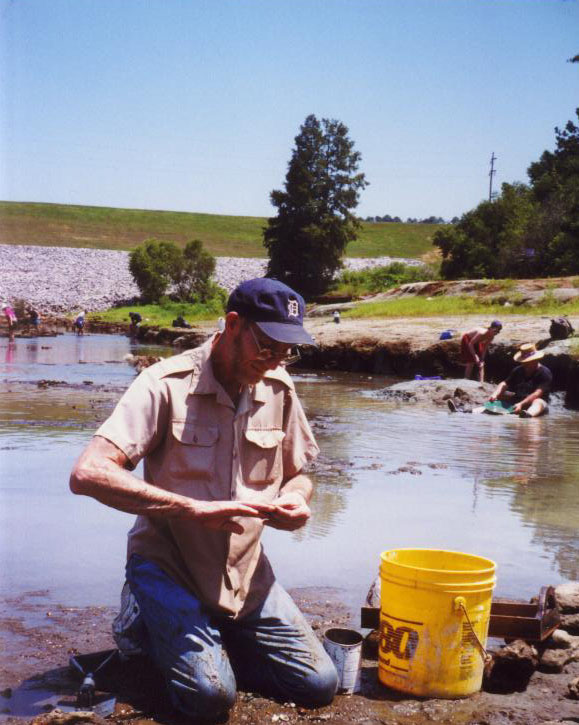
Henry Edmonson |
|
Ron Buta (facing the camera) |
|
David Shepherd |
|
Bill and Kate Newman |
|
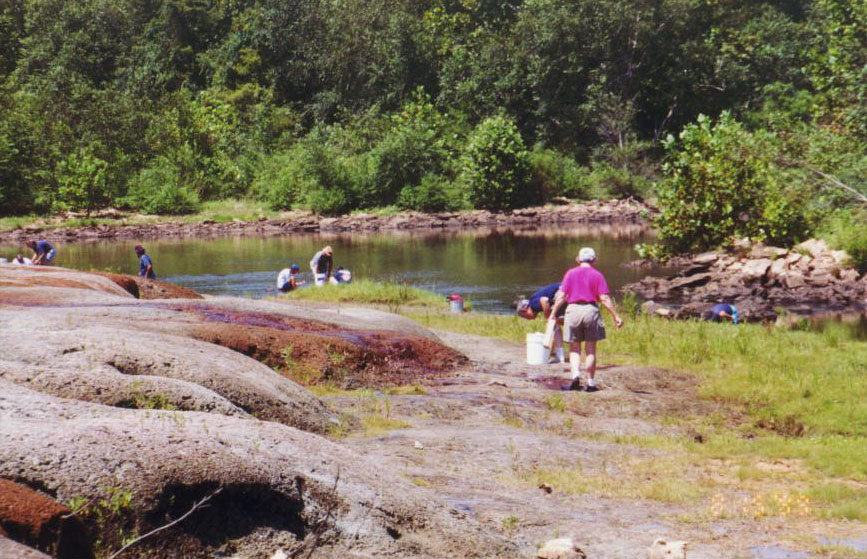
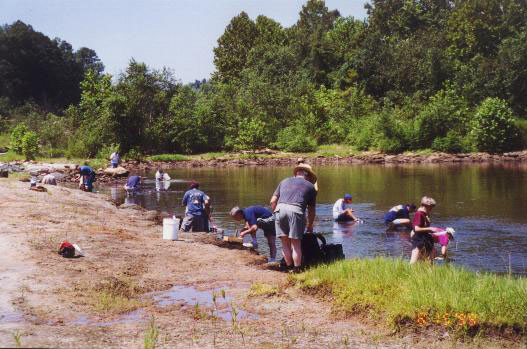
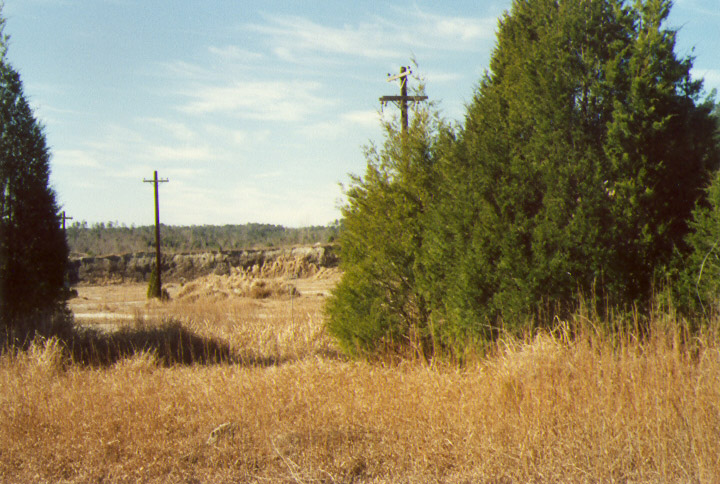
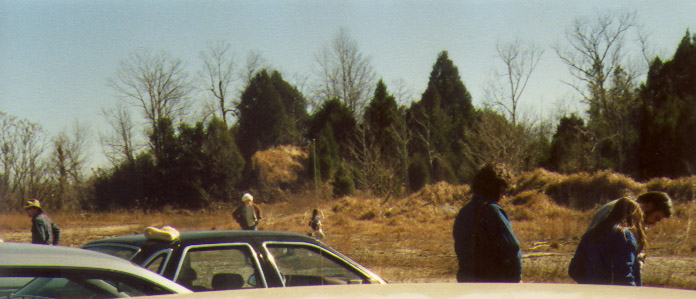
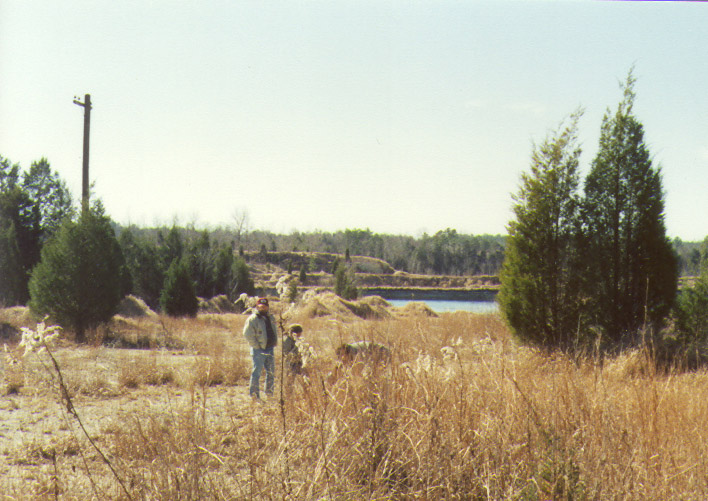
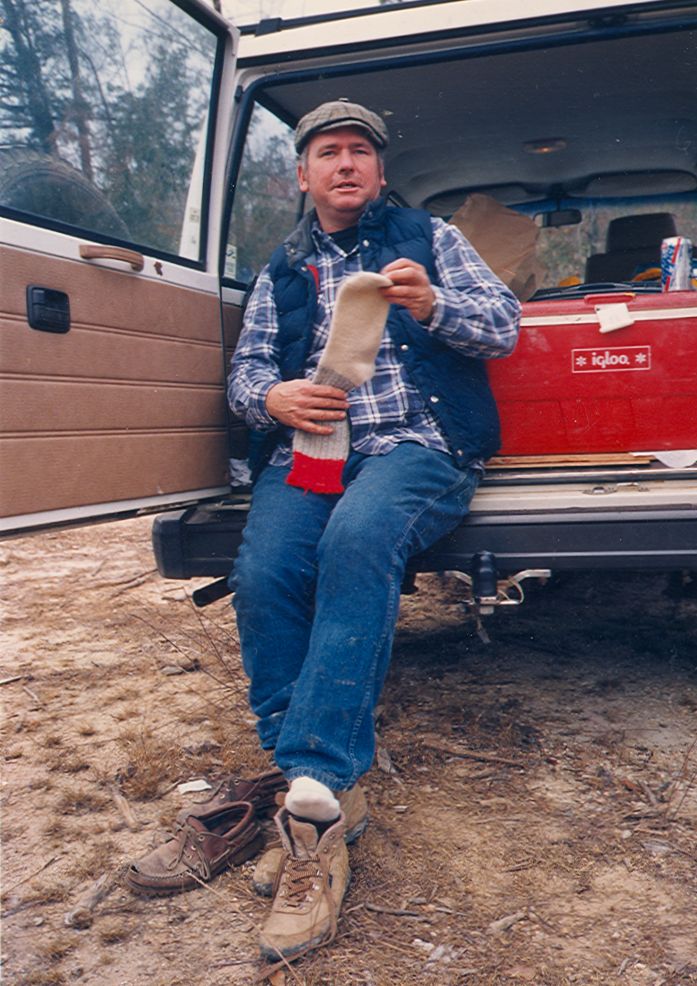
Fossils found included sharks teeth, ray teeth, petrified wood, and vertebrae of sea snakes. The time period represented in the site we worked was the Eocene, the early age of Mammals, approximately 40-50 million years ago. From this site we proceeded to a private museum. A fascinating exhibit!
January, 1990 - Washington Co, AL
Greg Mestler